

Transforming a Devon coastal cottage into a modern retreat starts with a site-led strategy that prioritizes light, airflow, and durability. Align your layout to maximize sea breeze, open sightlines, and compact yet flexible spaces, then select a coastal palette of creams, grays, and pale blues with durable, low-maintenance materials. Use weather-resistant finishes, coastal-grade metals, and timber treatments, while preserving essential character with authentic regional crafts. Subtle tech enhances comfort without clutter—and there’s more to optimize as you progress.
Key Takeaways
- Align design with coastal Devon context by merging traditional craft with modern, low-maintenance materials resistant to salt, humidity, and wind.
- Create an airy, open-plan layout that extends living spaces outdoors, leveraging garden connections and sea views.
- Use a restrained coastal palette of creams, grays, and pale blues with durable finishes that age gracefully.
- Emphasize natural daylight and soft, warm artificial light to mirror Devon’s seasonal mood and enhance comfort.
- Integrate local craftsmanship, FSC timbers, and regional ceramics to root the retreat in place.
Why a Devon Coastal Cottage Deserves a Modern Retreat
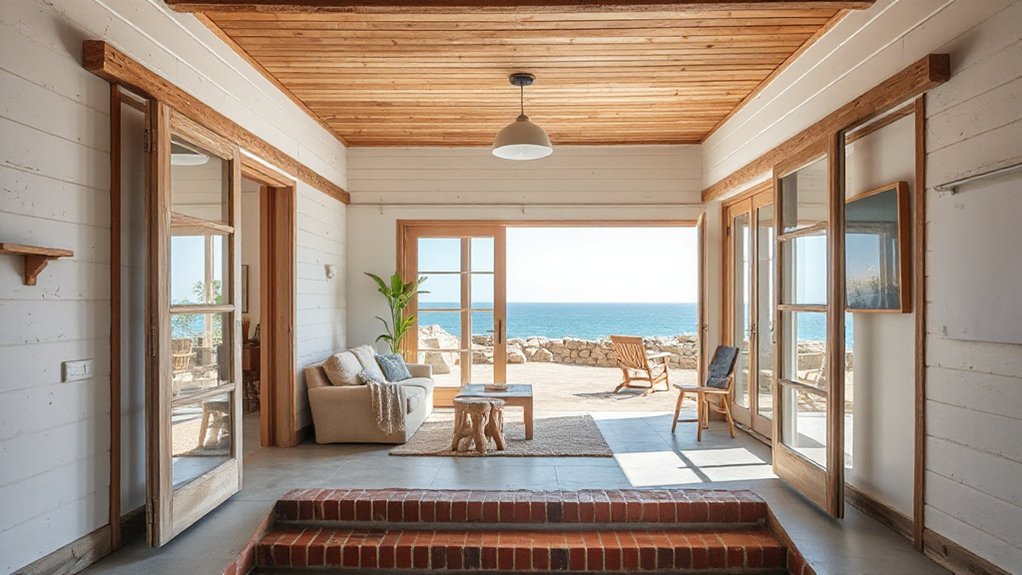
A Devon coastal cottage deserves a contemporary escape because its location combines natural splendor with practical requirements that call for robust design. You utilize the site’s exposed conditions to justify structural durability, moisture control, and energy conservation as core criteria. In this scenario, seaside gardening becomes more than visual appeal; it supports microclimate regulation, dune-stabilization, and biodiversity while maintaining low upkeep. You incorporate coastal art thoughtfully, ensuring materials, finishes, and textures resist salt mist and wind erosion without compromising the indoor-to-outdoor connection. The retreat emphasizes resilient materials, precise craftsmanship, and adaptable systems that respond to seasonal variations. You prioritize efficient insulation, ventilation, and water management to reduce ongoing expenses. This strategy aligns lifestyle comfort with long-term value, transforming a Devon cottage into a purpose-designed, enduring modern sanctuary.
Assess the Site: Light, Weather, and Sea Breeze
The site’s light, weather, and sea breeze define every design decision, so begin by mapping solar exposure across seasons and prevailing wind patterns to optimize orientation, shading, and ventilation. You evaluate how morning sun impacts living spaces, afternoon glare, and thermal cycling, then quantify diurnal and seasonal shifts to size shading devices and operable windows accordingly. You document microclimates created by coastal topography, dunes, and vegetation, aligning envelope details with predicted wind corridors to maximize natural ventilation without compromising privacy. You consider seaside flora for habitat-friendly landscaping, and coastal wildlife pathways to minimize disturbance while enhancing outdoor spaces. This disciplined assessment informs material selection, moisture management, and protective detailing, ensuring resilience against salt, humidity, and wind-driven weather.
Define Your Goals for a Coastal Devon Home
Set clear objectives for how you’ll live in the Devon coast, aligning milestones with budget, timeline, and sustainability targets. Prioritize coastal aesthetics to guarantee materials, colors, and textures reflect the environment without compromising practicality. Plan a functional layout that supports daily routines and future needs while preserving views, light, and flow.
Define Clear Objectives
To establish success, start by articulating clear objectives for your Devon coastal home: what you’ll enjoy daily, what constraints you’ll work within, and how the project will support your long-term lifestyle. You’ll define measurable targets for function, comfort, and efficiency, then align them with site realities. Specify key performance indicators for thermal performance, moisture management, and durability under coastal conditions. Establish a decision framework that balances contemporary needs with historical preservation and local traditions, ensuring compliant, respectful integration. Map budget boundaries, timeline milestones, and risk controls to prevent scope creep. Translate objectives into design criteria, material choices, and construction standards that yield repeatable outcomes. Finally, document ownership responsibilities and review cadence to sustain clarity throughout the project lifecycle.
Prioritize Coastal Aesthetics
As you plan a coastal Devon home, prioritize aesthetics that honor the shoreline context while delivering practical living space. You define goals that fuse coastal flora with durable materials, ensuring resilience against salt and wind. Seaside artifacts guide accents that read as timeless, not trendy, and they align with maintenance cycles. Your prioritization translates to four concrete steps:
- Establish a restrained color palette inspired by dunes and seaweed.
- Select materials with coastal performance—creams, grays, and weathered finishes.
- Integrate low-profile, open sightlines to maximize natural light and views.
- Curate seaside artifacts as focal notes, positioned for longevity and minimal upkeep.
This framework supports a cohesive, future-proof retreat where aesthetics support daily function and environmental context.
Plan Functional Layout
Design a layout that foregrounds daily function while honoring coastal context. You’ll define spatial priorities by mapping routines, traffic flow, and storage needs first, then translate them into a cohesive plan. Assess room adjacencies to minimize progressions; position wet areas near exterior access for coastal wear, and orient living spaces to capture natural light without glare from prevailing winds. Establish clear zones for cooking, dining, work, and relaxation, and enforce circulation widths that support accessibility. Integrate durable finishes and moisture-conscious detailing to sustain the Devon climate. Plan for future adaptability, including a potential bedroom repurpose or home-office niche. Consider a garden redesign that extends the interior experience outdoors, and weave vintage charm into built-ins and hardware without compromising performance. This approach yields a resilient, versatile layout.
Plan the Layout: Open Flow for Small Spaces
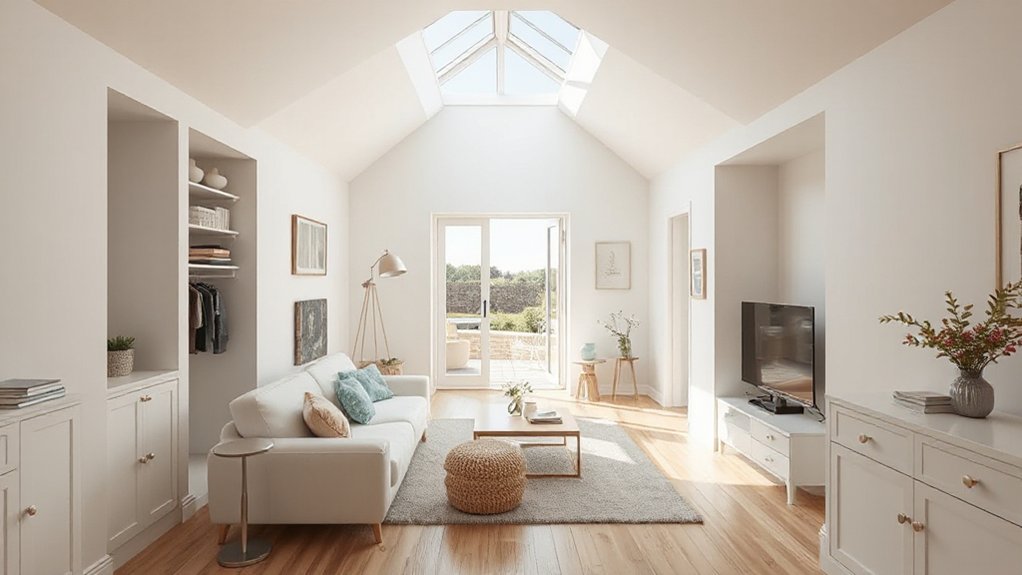
Careful planning releases an open feel without sacrificing function. For small spaces, you optimize circulation, sightlines, and furniture scale to maintain airflow and utility. Use zones rather than walls to define uses, allowing flexible movement without visual clutter. Prioritize built-ins and hidden storage to reduce bulk. Align windows and door swings to minimize barriers, enabling seamless progression between living, dining, and prep areas. Material choices should reflect durability and light reflection to amplify brightness. Keep color contrast restrained to avoid heaviness while maintaining definition. Incorporate the following tactics:
- Elevate multi-purpose pieces that tuck away when not in use
- Choose linear, low-profile furnishings to preserve sightlines
- Position seating to enhance conversation and flow
- Use rugs to delineate zones without walls
Coastal flora, Seaside wildlife.
Choose a Coastal Devon Palette: Textures and Neutrals
Choosing a coastal Devon palette hinges on textures and neutrals that reflect light, endure the marine climate, and read as cohesive backdrops for living spaces. You select tonal foundations that pair with variable light—sand, shell, and drift comprise the core spectrum. Focus on finishes that resist humidity without appearing clinical: matte plaster, oiled timber, and low-sheen fabrics. Subtle contrast enhances depth while maintaining serenity, so balance warm whites with cool stone grays and pale blues. Introduce texture through woven upholstery, sisal rugs, and linen drapery, ensuring coastal textiles remain durable under daily use. Integrate seaside flora-inspired accents as restrained motifs rather than focal statements. This approach yields room-to-room cohesion, promotes clarity of line, and supports a calm, modern retreat throughout your Devon cottage.
Materials That Endure Seaside Living
Durable coastal materials and weather-resistant finishes form the backbone of a resilient Devon retreat. You’ll prioritize materials that withstand salt air, humidity, and wind-driven spray while preserving a clean, timeless aesthetic. This discussion starts with selecting finishes that endure exposure and detailing that minimizes maintenance without compromising in-situ performance.
Durable Coastal Materials
What durable coastal materials best withstand salt spray, wind, and shifting dunes? You’ll select a kit of proven options that persist in harsh coastal microclimates. Choose materials with low porosity, robust corrosion resistance, and predictable performance under load. The aim is to harmonize resilience with minimal maintenance, while honoring beachfront flora and maritime artifacts as contextual cues. Use materials that resist moisture ingress and salt crystallization, and favor mechanical stability under shifting sands. Consider assemblies that avoid galvanic incompatibilities, prevent deck deformation, and deter wood decay.
- Stainless steel fasteners and coastal-grade aluminum framing
- Fibre-reinforced concrete and silica-rich mortars
- Marine-grade timber treatments and durable laminates
- Powder-coated steel, ceramic tiles, and non-porous claddings
Weather-Resistant Finishes
Weather-resistant finishes protect coastal interiors from salt spray, humidity, and dune-driven air movement. You select coatings that resist moisture ingress, UV degradation, and salt corrosion, ensuring long-term performance in exposed settings. Start with substrates treated for dimensional stability, then apply primers tailored to gypsum, timber, or masonry, followed by topcoats with low pigment pull and flexible binders. Weatherproof finishes should exhibit low VOCs, compatibility with metal hardware, and resistance to cracking from temperature swings. In practice, you prioritize coastal paint durability through systems that maintain colorfastness and surface integrity, reducing maintenance cycles. When detailing, document film thickness, recoat windows, and substrate prep, aligning with manufacturer data sheets. This approach enhances durability, minimizes upkeep, and preserves aesthetic clarity in harsh seaside climates.
Local Craft: Bringing Devon to the Interior
Local craft grounds the interior in Devon’s character by integrating regional materials and artisanal techniques into every room. You’ll notice how timber beams, local stone, and handmade porcelain fuse with modern layouts, creating a tactile, cohesive environment. The approach centers on precise Craftsmanship techniques and purposeful material selection to sustain authenticity while meeting durability goals. You’ll collaborate with local artisans to source unique textures and patterns that echo coastal weathering without sacrificing polish. 4 key elements define the strategy:
- Sourcing regional lumbers and FSC-certified timber
- Employing traditional jointing and hand-finishing methods
- Integrating Devon-made ceramics and textiles
- Documenting processes via a collaborative design brief with craftspeople
These local artisan collaborations ensure a refined, enduring interior that resonates with place and retains contemporary clarity.
Durable Floors and Tactile Ceilings for Coastal Life

Durable floors and tactile ceilings are engineered to withstand coastal conditions while enhancing sensory appeal. You select materials with low water absorption, slip resistance, and stable finishes to resist salt, humidity, and sand intrusion. In flooring, you prioritize high-density composites, performance vinyl, or engineered hardwood sealed for moisture, ensuring dimensional stability and long-term wear. For ceilings, you favor embossed or sculpted textures that improve acoustics while remaining wipeable and resistant to corrosion. You’ll specify seamless junctions, minimal gaps, and concealed fasteners to reduce maintenance. The result delivers Seaside serenity underfoot and overhead, with Coastal durability evident in edge protection, anti-microbial coatings, and UV-stable pigments. Precision detailing, standardized testing, and durable finishes converge to sustain an enduring, practical marine atmosphere.
Kitchen Layouts That Maximize Views and Efficiency
To maximize both views and workflow, consider a galley or u-shaped layout that aligns key work zones along a single corridor or compact circle, reducing movement while expanding sightlines to the outdoors. In this setup, you’ll integrate storage and appliances to minimize trips, preserving clean lines and uninterrupted coastal views. The result is a kitchen that supports quick tasks and deliberate, scenic moments.
- Prioritize line-of-sight between the prep area and windows to frame Seaside flora while cooking.
- Place secondary work zones along adjacent walls to maintain flow without crowding the main corridor.
- Use inset cabinetry and hidden appliances to keep surfaces calm and coastal fashion-inspired finishes visible.
- Design seating to capture key view axes, enhancing sociability without interrupting work zones.
Bathrooms With Spa-Like Calm and Sea-Inspired Detail
A spa-like bathroom blends quiet, tactile textures with marine-inspired color and light to create a tranquil retreat. You select materials that resist humidity while delivering subtle warmth, such as honed stone, ceramic timbres, and matte metal fixtures. The space uses a restrained palette—sea blues, warm beiges, and soft whites—to reflect coastal light without glare, enhancing perceived calm. Fixtures are compact but high-performance, with dual-flush toilets, low-flow taps, and programmable ambient lighting that shifts from cool to warm with the day. Storage remains recessed to preserve line, while underfloor heating adds tactile comfort. Ventilation is integral, mitigating humidity and preserving finishes. Finishes are sealed for maintenance, ensuring spa inspired serenity endures. Sea inspired accents punctuate the scheme with coastal texture and cohesion.
Lighting for Daytime Glow and Evening Mood

You’ll balance daylight brightness with strategic shading to preserve natural hues while reducing glare. By layering mood lighting, you create a seamless shift from daytime tasks to evening relaxation, using dimmable fixtures and selective accents. Consider coastal color temperature to preserve the seascape feel while ensuring skin tones and textures read correctly.
Daylight Brightness Balancing
Natural daylight should be treated as a primary design parameter, with brightness balancing achieved through measured window placement, glazing choices, and interior reflectance. You optimize ambient daylight to maintain consistent luminance while preventing glare and overheating, leveraging calibrated sunlight diffusion and interior shading strategies. This approach preserves daylight quality across rooms and times, enabling daytime glow without sacrificing evenings.
- Position windows to create even sky-light distribution and minimize hotspots
- Select glazing with low-e coatings and appropriate tints to modulate solar gains
- Apply interior reflectance targets on walls, ceilings, and furnishings
- Integrate exterior shading devices that respond to solar angle while preserving views
This method emphasizes sunlight diffusion and interior shading as core controls for balanced brightness and mood shifts.
Mood Lighting Layering
Mood lighting layering builds on daylight optimization by using layered sources and controllable luminance to sustain daytime glow while shaping evening mood. You deploy a mix of ambient, task, and accent luminaires, calibrated for consistent color rendering and minimal glare. Dim-to-warm controls, plus scene presets, allow progressions—from bright, focused work to soft, enveloping evenings—without visual jolt. In practice, you interlock dimmers with intelligent controls, ensuring automatic adjustments tied to occupancy and time of day. Vintage charm comes from choosing fixtures with period cues, while rustic accents are reinforced by warm metal finishes and natural materials. You preserve architectural integrity by outlining luminaire planes that respect sightlines and reflections. The result is a cohesive, adaptable environment that enhances coastal textures and supports subtle, durable mood shifts.
Coastal Color Temperature
Coastal color temperature balances daylight accuracy with evening warmth to preserve the site’s maritime character. You optimize light toward seaside hues, aligning color temperature with time of day to enhance texture, material, and view. In daylight, use ~5500K–6500K for crisp, neutral truth; indoors, shift to 2700K–3000K during dusk to evoke sheltering glow. This progression supports both function and mood without erasing the coast’s identity. Apply these principles across zones to maintain coherence and avoid color drift.
- Daylight task lighting at 5500K–6500K for kitchens and work areas.
- Ambient accents at 2700K–3000K for evenings, sea-pine furniture, and fabrics.
- Dimmed layers keep warmth without losing seaside hues.
- Controls automate gradual shifts to match outdoor conditions.
Subtle Tech That Preserves a Serene Aesthetic
To preserve a serene aesthetic, integrate discreet tech that supports daily life without drawing attention. Subtle tech relies on hidden interfaces, low-profile hardware, and centralized control that becomes invisible as you move through the cottage. You’ll prioritize human-centric automation: scenes that adjust lighting, climate, and audio with minimal intervention, maintaining a calm environment. Choose smart appliances that blend with cabinetry and finishes, avoiding glossy and conspicuous finishes. Guarantee cables are routed behind walls or within conduit so surface spaces stay clean. Tech integration should focus on robust reliability, privacy, and quick access when needed, not showmanship. Documented calibration of sensors preserves consistent ambience across rooms. This approach enhances comfort while preserving the Devon cottage’s coastal simplicity and timeless character.
Outdoor Connections: Patios, Decks, and Garden Rooms
Outdoor connections extend the living space seamlessly beyond the cottage walls, linking patios, decks, and garden rooms with robust, weather-tolerant design. You optimize flow and sightlines, ensuring durable materials withstand salt spray while remaining understated. Seaside wildlife and coastal flora influence plantings and shade strategies, preserving coastal character. You implement low-profile joints, slip-resistant surfaces, and concealed drainage to minimize maintenance.
- Specify corrosion-resistant fasteners and timber treatments for longevity.
- Align deck heights with interior thresholds to reduce trip hazards.
- Integrate permeable paving to manage runoff and encourage drainage.
- Use modular garden rooms with adjustable screens for seasonal openness.
This approach delivers integrated exterior living that remains resilient under salt-laden winds, supporting year-round enjoyment and sustainable coastal aesthetics.
Budgeting a Modern Coastal Transformation

Balancing ambition with budget starts with a clear cost framework that mirrors the coastal cottage’s modern retrofit. You establish a tiered budget, separating hard costs (structure, insulation, windows) from soft costs (design, permits, contingencies). Prioritize high-impact upgrades that improve resilience and value, then allocate reserves for overruns. When selecting Sustainable materials, balance life-cycle costs against upfront price, ensuring moisture resistance and low maintenance in a coastal environment. Compare prefabricated components to on-site builds to optimize schedule and waste. Integrate Smart home technology where it elevates efficiency, comfort, and monitoring without inflating complexity or cost. Use procurement oversight, value engineering, and phased spending to maintain cash flow. Document decisions with line-item tracers, enabling accurate reporting and future retrofits.
Maintenance Mindset: Protect and Preserve the Devon Soul
Maintenance mindset starts with structured care routines that shield the Devon cottage from moisture, salt spray, and seasonal wear. You establish a preventive cadence, documenting seasonal checks and implementing proven protective measures to retain character while resisting corrosion and decay. Focus on targeted maintenance that sustains the seaside vibes without eroding structure or aesthetics, ensuring the home remains resilient and cohesive with its coastal setting. To operationalize this mindset, follow these core practices:
- Schedule humidity and ventilation controls to deter mold and wood rot.
- Inspect exterior finishes, sealants, and fasteners for salt exposure and recoat as needed.
- Maintain windows, doors, and hardware for airtight, weatherproof performance.
- Align upkeep with the seaside flora and chosen nautical decor to preserve Devon soul.
Frequently Asked Questions
How to Protect Timber From Salty Coastal Air Long-Term?
To protect timber from salty coastal air long-term, you should apply Harsh weatherproofing and Salt resistant finishes, seal joints, use rot-resistant timber, maintain coatings regularly, and guarantee adequate ventilation, UV protection, and ongoing inspection for corrosion and deterioration.
What Budget Trade-Offs Matter Most in Devon Upgrades?
You should prioritize interior lighting upgrades and energy efficiency, because coincidence trips you up otherwise, revealing cost-saving opportunities you’ll actually use. You’ll balance upfront lighting quality with long-term efficiency, selecting LED schemes and smart controls for Devon upgrades.
Which Seaside Materials Age Best Indoors?
Seaside durability proves most robust indoors, with salt-resilient tiles, sealed wood, and epoxy paints; coastal aesthetics influence palette and texture. You’ll prioritize moisture resistance, long-term finishes, and easy maintenance, ensuring durable, visually cohesive spaces that age gracefully.
How to Preserve Devon Character With Modern Fittings?
You preserve Devon character by blending Coastal heritage with discreet modern fittings, ensuring Traditional craftsmanship remains visible. You balance materials, proportions, and textures, and you document detailing to maintain authenticity while integrating sustainable upgrades and contemporary performance.
What Permits or Approvals Are Needed Locally?
Building regulations require you to check with local planning and building control; coastal zoning may impose restrictions on bay windows, materials, and setbacks. You secure approvals before work, ensuring compliance with permits, certificates, and timely inspections.
Conclusion
You’ll finish this coastal rebuild with a home that breathes like the tides—calm, resilient, and utterly you. Every material choice and layout tweak locks in light, airflow, and ease, while preserving Devon’s soul beneath a modern veneer. Embrace textures that murmur of sea spray, neutrals that ground, and subtle tech that vanishes into the view. Stand back, watch the salt-kissed glass gleam, and feel the interior becoming a living shoreline—quiet, deliberate, and persistently inviting.
About the Author