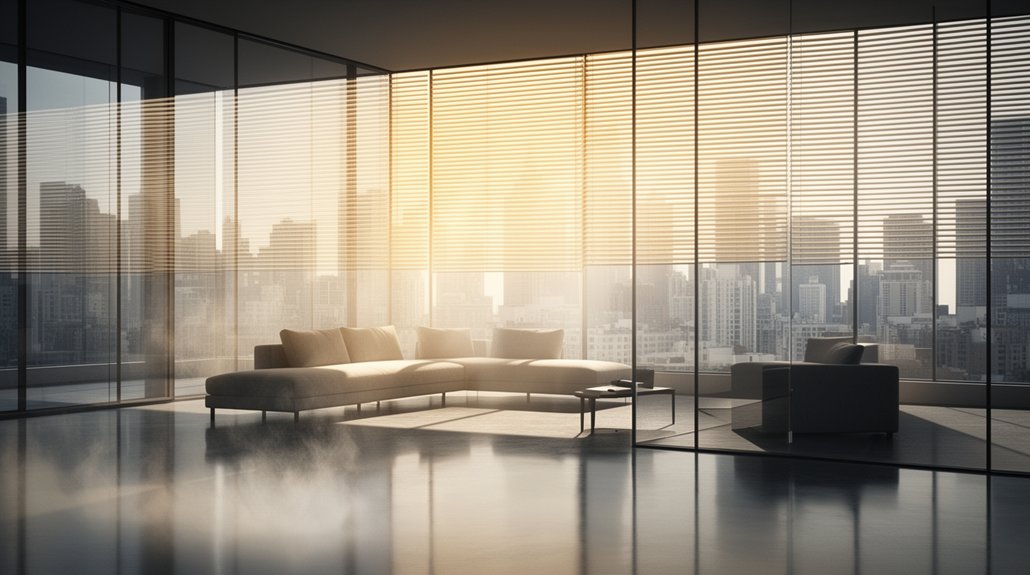
Smart windows and blinds automatically manage natural light by syncing tinting, shading, and sensor data with your routines and environment. Auto-tinting glass uses light and heat sensors to darken during bright conditions and lighten when dim, balancing glare, daylight, and energy use. Automatic shades—roller, Roman, and pleated—offer fast, precise control, while hybrid strategies combine schedules with real-time adjustments for comfort and efficiency. You’ll discover setup, integration, and optimization tips if you keep exploring.
Key Takeaways
- Smart windows dynamically adjust light transmission and tint to optimize daylight, glare reduction, and comfort based on sensors and ambient conditions.
- Automatic shading systems (roller, Roman, pleated) provide fast, durable, and integrated light control with smart controllers.
- Hybrid control combines scheduling, real-time sensor data, and manual overrides for predictable energy use and responsive adaptation.
- Room-by-room management allocates luminance by occupancy and task needs, synchronizing natural and artificial lighting with daylight harvesting.
- Privacy, glare, and view balance are achieved with dynamic shading, coatings, and selective openness while preserving sightlines and comfort.
How Smart Windows Brighten Rooms and Cut Glare
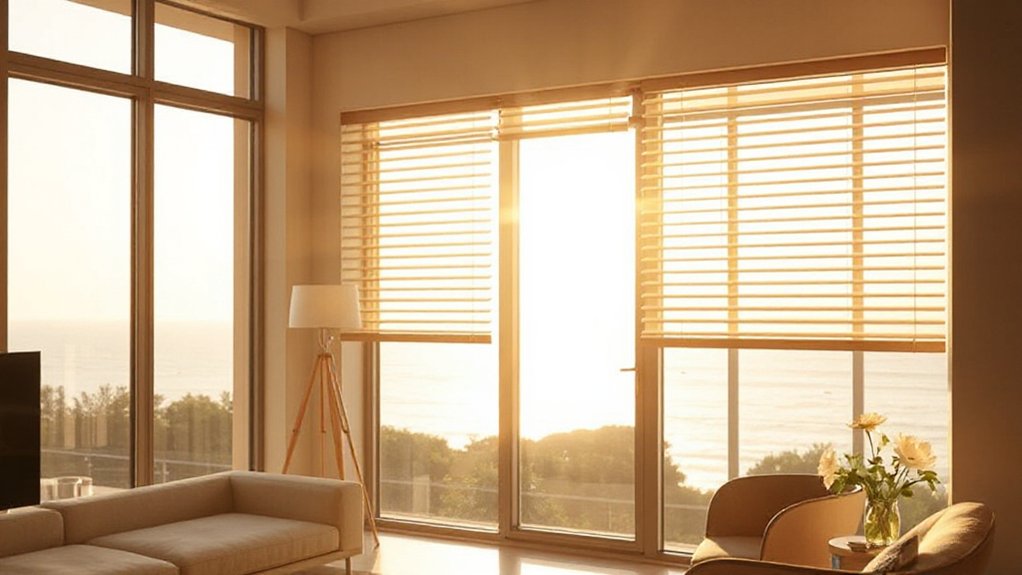
Smart windows brighten rooms and reduce glare by dynamically adjusting light transmission. You optimize daylight without manual shifts, using sensor data to modulate transmitted light. As ambient brightness rises, the system lowers transmission to preserve contrast and prevent washed-out visuals. When daylight wanes, transmission increases to sustain usable illumination, reducing reliance on artificial lights. You can tailor color temperature to match tasks; cooler scales sharpen perceived brightness for work, while warmer tones improve comfort for reading or relaxation. Window tint options further shape performance, balancing glare control with visibility. Precision control minimizes flicker and color shift, ensuring consistent appearance across spaces and times of day. In sum, smart windows enhance brightness, stabilize contrast, and optimize comfort through adaptive tinting and color temperature management.
How Auto-Tinting Glass Works in Homes and Offices
Auto-tinting glass adjusts its transparency in real time based on light and heat sensors, without manual input. In homes and offices, a smart coating or laminated layer responds to ambient brightness, infrared heat, and spectrum composition to modulate visible transmission. When daylight is intense, the glass darkens to reduce glare and maintain comfort, while in dim conditions it lightens to maximize natural illumination. The system prioritizes energy efficiency by balancing solar heat gain with cooling loads, preserving interior color perception and occupant well-being. Color temperature affects perceived tint, guiding the control algorithm toward consistent white balance across rooms. UV protection is integrated to limit ultraviolet radiation, protecting furnishings and reducing long-term material degradation. This autonomous adjustment minimizes manual interventions and supports passive design goals.
Automatic Shading Systems: Roller, Roman, and Pleated in Practice
Roller, Roman, and Pleated systems each offer distinct control profiles for automated shading in real-world environments. You’ll compare roller ease, Roman fabric aesthetics, and pleated flexibility to determine which best meets daylight, privacy, and energy targets. This discussion starts with practical performance contrasts and moves toward selection criteria for various glazing contexts.
Roller System Insights
Roller systems offer fast, reliable shading by winding fabric between a tube and a panel, enabling precise light control with minimal intrusion. You’ll value consistent lift and balanced tension, which guard against sag and flutter across long spans. Material durability matters here: advanced polymers and layered coatings resist UV exposure, heat, and abrasion, preserving color, opacity, and performance over time. The streamlined profile limits air resistance and simplifies integration with smart controllers, sensors, and motor housings. Aesthetic design remains integral, with fabric textures, finishes, and housing colors shaping the room’s character while maintaining functional efficiency. Installation and routine maintenance benefit from accessible spring-tloat adjustments and easy fabric replacement. Overall, roller systems blend durability, precise control, and clean aesthetics for dependable, low-profile shading.
Roman and Pleated Benefits
Roman and pleated shades offer distinct advantages in automatic shading systems, delivering tailored light control and enhanced aesthetics without sacrificing efficiency. In practice, you gain precise ambiance adjustments and reliable performance across varying daylight conditions, aligning with historical architecture nuances while preserving energy targets. These shades support color customization, enabling cohesive interior palettes without compromising function. You’ll experience smoother operation, reduced fabric sag, and faster response times when integrated with smart controls.
- Precise light filtration maintains architectural integrity
- Color customization complements period details and modern apps
- Efficient privacy management with minimal motor load and wear
Sensors and Connectivity: The Eyes of the System
Effective sensors and reliable connectivity define how you monitor light, occupancy, and shading cues in real time. We’ll examine sensor placement strategies, the protocols that guarantee robust communication, and how data privacy considerations shape system architecture. This discussion sets the foundation for scalable, secure, and responsive smart window behavior.
Sensor Placement Strategies
Where should you place sensors to optimize visibility, responsiveness, and reliability in smart windows and blinds?
Strategic placement guidelines:
- Position light sensors at unobstructed angles to the primary daylight source, avoiding shadows from blinds or furniture, and near typical glare zones.
- Install calibration-ready sensors in representative interior zones to support accurate Sensor calibration and robust performance across varying occupancy and lighting conditions.
- Locate controls and processing nodes within a low-noise ambient region to minimize interference and ensure consistent data fusion.
Notes:
- Use service-accessible housings for periodic recalibration and field diagnostics.
- Validate placement with daylight profiles and simulate seasonal shifts to preserve responsiveness and reliability.
Connectivity Protocols Used
Smart windows and blinds rely on robust connectivity to guarantee real-time data exchange between sensors, actuators, and processing nodes. You deploy standardized protocols to minimize latency, assure reliability, and support multi-hop layouts where devices span rooms or zones. Typical choices include low-power wireless stacks for battery-operated modules and wired field buses for fixed installations, each balancing bandwidth, interference resilience, and scalability. You select protocols with built-in security features and deterministic timing to meet automation deadlines while preserving energy efficiency. Network topology is configured for fault tolerance, with redundant paths and auto-recovery. Protocols must accommodate device discovery, secure pairing, and over-the-air updates. Material durability, aesthetic appeal.
Data Privacy Considerations
Sensor data from windows and blinds represents the system’s vision and must be protected end-to-end from capture to processing. You operate in a connected environment, so privacy must be designed in by default, not bolted on afterward. This section outlines essential practices to safeguard data and respect user autonomy.
- Data encryption is mandatory in transit and at rest, using strong, up-to-date algorithms and key management.
- User consent is required before collecting or sharing sensitive metrics, with clear disclosure of purposes and retention limits.
- Access controls and auditing ensure only authorized entities view or modify data, supported by ongoing privacy impact assessments.
Implement these measures to maintain trust, meet compliance, and minimize exposure to breaches or misuse.
Scheduling vs Real-Time Automation: Make the Call

Scheduling and real-time automation each offer distinct advantages for smart windows and blinds. You’ll weigh predictability against responsiveness to changing conditions, then decide which approach fits your environment. Scheduling excels when light patterns are consistent, energy targets are fixed, and you want low runtime variance; it reduces decision fatigue and preserves device life. Real-time automation shines when external factors—sun angle, cloud cover, occupancy—vary or when privacy needs shift rapidly. Implement a hybrid approach: schedule baseline rigs, then apply sensor-driven adjustments. Critical steps include sensor calibration to ensure accurate daylight readings and scene selection. Don’t overlook manual override for emergencies or unusual events. Clear policy flags, audit trails, and fail-safe defaults help maintain control without sacrificing efficiency or comfort. Choose a method, document rationale, and monitor performance.
Room-By-Room Light Management Strategies
You optimize room lighting by allocating available luminance where it’s needed most, balancing occupancy, task needs, and daylight. Window control tactics coordinate blinds with sensors and schedules to reduce glare while preserving natural light benefits. This discussion centers on how room-by-room light allocation and window control strategies create consistent, energy-efficient illumination across the home.
Room Light Allocation
Room light allocation assigns illumination where it’s most needed, optimizing comfort and energy use room by room. You implement targeted brightness, color temperature, and zoning to align with activities while preserving daylight benefits. This approach reduces waste and enhances perceived quality through precise control of luminance distribution and contrast.
- Assign zones by function, room orientation, and occupancy to ensure consistent task lighting without oversupply.
- Calibrate color temperature to support mood lighting while meeting visual task requirements, switching from cool to warm as needed.
- Synchronize artificial and natural light with dimming profiles that respect daylight shifts and energy targets.
This method delivers predictable performance, supports visual acuity, and maintains atmosphere without compromising efficiency or safety.
Window Control Tactics
Window control tactics optimize room-by-room daylight use and shading automation, aligning glazing and blind strategies with occupancy patterns and activity needs. You implement a layered approach: assign shading modalities by space function, adjust curtains or louvers for glare reduction, and set automated schedules tied to daylight sensors. In offices, prioritize vertical blinds for direct sunlight hours and switch to dimmable glazing in conference zones to preserve views. For residential spaces, couple exterior shading with interior drapes to manage seasonal changes. Consider color coordination to minimize perceived brightness shifts and maintain consistent aesthetics across rooms. Material durability matters: select tracks and fabrics with proven wear resistance for frequent operation. Validate performance with occupant feedback, then refine routines to sustain energy savings and visual comfort over time.
Privacy, Glare, and View: Balancing the Trio
Balancing privacy, glare reduction, and outward view requires a systematic approach to window technology. You evaluate materials, coatings, and control logic to protect privacy without sacrificing daylight quality or exterior perception. The goal is to minimize noise exposure from neighbors while preserving a comfortable, aesthetically cohesive interior.
- Assess privacy concerns against visible translucency and surface texture.
- Evaluate glare reduction with dynamic shading, high-contrast materials, and tuned tinting.
- Maintain outward view through rational layer stacking and selective openness, ensuring the aesthetic impact stays aligned with design intent.
The result is a precise balance: you gain controllable privacy, reduced glare, and preserved sightlines, all supported by transparent performance data and predictable behavior.
Energy Savings: How Daylight Programs Cut Cooling Loads
Daylight-driven cooling strategies leverage sensor-guided shading to reduce solar heat gain during peak sun hours. Automated shade optimization adjusts venetian blinds and skylight controls in real time, lowering cooling loads without compromising daylight. You’ll see measurable energy savings as you balance daylight delivery with shade responses to occupancy and weather.
Daylight-Driven Cooling
To reduce cooling loads, daylight-driven strategies leverage natural light to minimize heat gain while maintaining indoor comfort. By aligning glazing properties with shading controls, you curb solar gains while preserving illumination. Key mechanisms include solar reflection, daylight harvesting, and selective glazing.
- You use solar reflection techniques to reflect excess solar energy away from occupied zones, reducing cooling demand.
- You implement daylight harvesting to maximize usable daylight, allowing downsized artificial cooling and lighting loads.
- You integrate responsive glazing and shading schedules that adapt to sun position, preserving comfort without overcooling enclosures.
In practice, the approach lowers peak loads, smooths indoor temperature fluctuations, and enables smaller HVAC equipment. Efficient implementation relies on precise sensor feedback and calibrated control sequences to sustain comfort with minimal energy use.
Automated Shade Optimization
Automated shade optimization streamlines how blinds and dynamic glazing respond to sun angles and occupancy, delivering tangible energy savings by reducing cooling loads. You configure cues from schedules, ambient light sensors, and occupancy data, allowing system-wide coordination between blinds and glazing to maintain comfortable interior temperatures with minimal HVAC input. The approach prioritizes cooling load reduction while preserving daylighting quality, using phase-shifted operations and adaptive control algorithms. You can implement color customization to match interiors and enhance glare management without compromising performance. When needed, a manual override lets you override automatic decisions for immediate comfort or privacy, then re-engage autonomous control seamlessly. Real-time feedback and reporting enable precise performance verification, supporting commissioning, diagnostics, and ongoing optimization of energy savings.
AI and Smart Hubs: Personalizing Light Environments
AI and smart hubs enable dynamic, personalized light environments by analyzing occupancy, daylight levels, and user preferences to orchestrate shades, blinds, and lighting. You gain consistent comfort, reduced energy use, and seamless scene shifts across rooms, all while preserving architectural intent. This approach supports aesthetics and function through centralized control, enabling precise adjustments for task lighting, ambiance, and glare management. It also enables historical preservation by minimizing invasive retrofits and maintaining original fenestration appearances.
- Centralized learning of user routines and daylight patterns
- Fine-grained control of shades, blinds, and luminaires per zone
- Profiles that balance aesthetic customization with energy goals and preservation
Choosing Between Motorized Blinds and Smart Curtains

When deciding between motorized blinds and smart curtains, consider how each solution aligns with window orientation, insulation, and daily routines. Motorized blinds typically offer faster response, precise light control, and compact form factors suitable for narrow panes or irregular angles. Smart curtains provide a softer aesthetic, larger shade coverage, and easier integration with ambient lighting scenes for living spaces or bedrooms. Evaluate material options and durability, especially in high-traffic areas or sun exposure, since fabric translucency affects glare and privacy. Aesthetic styles matter: blinds favor minimalist, geometric interiors, while curtains suit traditional or premium décors. Assess consistency with existing hardware, maintenance needs, and upgrade paths, ensuring reliable motor control and seamless scene integration within your smart ecosystem.
Wiring and Power for Smart Windows
You’ll assess power requirements for smart windows, including voltage, current, and load estimation to guarantee reliable operation. We’ll outline wiring methods options and their trade-offs, from low-voltage bus layouts to standard AC feeds, with emphasis on safety and code compliance. We’ll also compare battery and backup solutions to maintain function during outages and to support seamless automation.
Power Requirements Overview
Power requirements for smart windows and blinds hinge on reliable, predefined supply standards and clear load budgeting. You’ll design for consistent voltage, current, and surge tolerance, ensuring stability during actuation cycles. Precision in power planning reduces nuisance trips and preserves longevity.
- Define supply voltage and maximum current per device, with margin for peak draws during movement.
- Specify energy efficiency targets and low-power standby modes to minimize idle consumption.
- Document protection features (fusing, overcurrent, transient suppression) and clear commissioning tests.
This approach prioritizes energy efficiency and user comfort by preventing voltage dips that degrade performance. You’ll also align with building codes and manufacturer guidelines to simplify integration, enable remote monitoring, and support predictable, reliable operation across your smart window network.
Wiring Methods Options
Wiring methods for smart windows and blinds must align with the defined power plan while guaranteeing reliable actuation and safety. You choose between low-voltage DC, line-voltage, or PoE options depending on proximity to electrical panels and required load. Keep wiring paths short and protected from physical damage, with proper conduit where needed. For integration, prefer centralized controllers that consolidate power and signaling, reducing noise and failure points. Consider dimmable drivers for precise speed and torque control, improving motion reliability. Guarantee compatibility with existing building wiring standards, and verify isolation between control lines and power conductors. Color customization and aesthetic integration should guide channel routing and mounting, minimizing visible cabling. Document cable gauges, fault protection, and surge considerations for maintainable, safe operation.
Battery and Backup Solutions
What backup power strategies best support reliable operation of smart windows and blinds when primary supply is interrupted? You gain resilience by selecting robust energy sources and clear interlocks. Focus on practical battery and backup configurations that minimize downtime and maintenance.
- Battery durability: opt for high-cycle, deep-discharge chemistries and rated thermal management to extend life under frequent cycling.
- Backup systems: pair uninterruptible power supplies or solar-ready storage with automatic transfer to ensure seamless operation during outages.
- Monitoring and maintenance: implement state-of-charge sensing, temperature monitoring, and automatic health alerts to sustain system reliability.
These approaches reduce data loss and mechanical stalls, preserving user comfort and privacy while ensuring consistent light control.
Compatibility: Integrating With Smart Home Platforms
Seamless integration hinges on standardized communication protocols, open APIs, and robust device compatibility lists; in practice, this means ensuring your smart blinds or smart windows support common ecosystems (such as Zigbee, Z-Wave, Wi‑Fi, or Bluetooth) and offer compatible control hubs. You’ll want native support for major platforms (e.g., Apple HomeKit, Google Home, Amazon Alexa) to minimize bridging complexity. Verify firmware update cadence, certification status, and device discovery behavior to avoid manual pairingdifficulties. Prioritize interoperable scene creation, automations, and occupancy awareness across devices to preserve Window aesthetics without compromising performance. Consider ecosystem impact on solar exposure management, device latency, and energy reporting. In short, cross‑vendor compatibility drives reliable automation, consistent control, and measurable solar impact benefits.
Privacy and Security: Protecting Your Automated Shades
Are you aware of the privacy and security risks that come with automated shades, and how to mitigate them effectively? You’ll address exposure and unauthorized access by adopting strict controls and robust protocols. Focus on encryption, strong authentication, and firmware updates to preserve window treatments integrity and user confidence. Implement network segmentation to limit breach impact and monitor for anomalies that could reveal your privacy concerns. Regularly audit device permissions and remove unused integrations to minimize attack surfaces. 1) Enable multi-factor authentication for hub access. 2) Keep devices on the latest firmware with automatic security patches. 3) Disable remote access when not needed and employ fail-safe auto-shutdown features. Prioritize secure defaults, user education, and transparent privacy settings to protect automated shades.
Maintenance Tips for Longevity and Performance
Regular maintenance is essential to keep smart windows and blinds performing reliably and lasting longer; start with a simple routine to prevent degradation. You should inspect tracks and seals quarterly, remove dust with a soft brush, and wipe surfaces with a microfiber cloth dampened in mild, noncorrosive cleaner. Check motors and actuators for smooth travel, listen for abnormal sounds, and recalibrate limits if travel stops are uneven. Schedule firmware updates promptly and back up configuration data to avoid loss after power events. For consistent light control, perform color calibration periodically to maintain color accuracy across displays and fabrics. Consider aesthetic customization by preserving finish integrity and avoiding harsh chemicals on decorative surfaces. Document maintenance actions and replace worn components before failures occur to preserve performance and reliability.
Budgeting: Cost vs. Benefit of Smart Light Control
Smart lighting control programs can deliver measurable savings without sacrificing comfort, so it’s worth evaluating cost versus benefit before upgrading. You’ll weigh upfront hardware, installation, and integration against long‑term energy reductions and comfort gains. Expect clear payback timelines when you account for occupancy patterns, climate, and existing blinds or shades.
1) Evaluate up-front costs vs. long-term savings, including potential tax incentives and warranty coverage.
2) Consider color customization and material durability of actuators and fabrics, ensuring compatibility with your interior design and climate exposure.
3) Assess maintenance needs, replacement cycles, and software support to avoid hidden expenses over time.
This framework helps you decide if smart light control delivers authentic value, not just novelty.
Real-World Case Studies: Homes That Learned to Light Themselves
Real-world deployments of smart windows and blinds demonstrate how automated light control adapts to daily rhythms and occupancy without user intervention. In these homes, sensing and scheduling align shade position and dimming with natural daylight shifts, reducing glare while preserving view access. You’ll see systems optimize color temperature by coordinating blind angles with electric lighting estimates, producing comfortable ambiances from morning warmth to evening cool tones. Case studies emphasize robust integration with window framing, ensuring seals and edge constraints don’t disrupt response times or liquid crystal shifts. Occupancy-aware logic prioritizes occupied zones, lowering energy use when spaces sit idle. Across varied climates, these deployments validate predictable performance, simplified fault detection, and gradual refinements through learning algorithms that tailor behavior to homeowner patterns.
Installation Timeline: DIY vs. Professional Help
Choosing between DIY installation and professional help hinges on system complexity, your skill set, and the project’s safety requirements. You’ll assess installation timeline by weighing preparation, mounting, and calibration steps against risk factors and wiring needs. Professional help often shortens timelines for complex motors, integration with smart hubs, and conduit routing, ensuring code compliance and consistent results. DIY can save costs, but may extend the schedule if you encounter unforeseen hardware compatibility or mounting challenges. Material durability and aesthetic design influence the planning phase, affecting bracket choices, trim alignment, and weather sealing. Plan accordingly with a structured approach:
- Define scope, verify components, and confirm compatibility.
- Schedule site inspection, install, and test sequences.
- Validate safety, finishes, and long-term maintenance implications.
Troubleshooting Common Automation Glitches
When automation glitches arise, start with a structured triage to isolate the issue quickly. Confirm system scope: shading unit, controller, and sensing module respond as expected. Check Power, network connectivity, and firmware versions; document any recent changes. If symptoms persist, test the manual override to verify independent operation and log deviations from automatic behavior. Review sensor inputs for color temperature mismatches or daylight variance that could trigger improper cycles, and calibrate if necessary. Inspect scene configurations and time schedules for overlaps, conflicts, or stale presets. Validate integration with hubs or voice assistants; disable third-party automations to rule them out. If anomalies recur, reset to defaults, reapply firmware, and reestablish secure connections. Record outcomes, then escalate to support with diagnostic data.
Future-Proofing Your Smart Light System
Future-proofing your smart light system starts with a forward-looking architecture that accommodates evolving standards, devices, and user needs. You design for interoperability, modularity, and secure updates to reduce obsolescence risk and downtime. By tracking Historical evolution, you anticipate shifts in protocols, data models, and power profiles, ensuring smooth migrations. You also account for regional variations in regulations, power plugs, and wireless spectrum, preventing compatibility gaps. The approach emphasizes open ecosystems, standardized APIs, and rollback-safe firmware, so you stay agile as vendors converge or split. Implement a governance model that preserves backward compatibility while enabling progressive enhancements. 1) Establish a reference architecture with pluggable components 2) Build a testbed that mirrors regional quirks 3) Adopt update cadences and deprecation timelines
How to Start a Smart Windows and Blinds Project Today
Starting a Smart Windows and Blinds project today requires a clear scope and a practical integration plan that aligns with your existing smart-home ecosystem. Begin with objective outcomes: automate daylighting, reduce energy use, and preserve comfort. Map system interfaces, selecting compatible motors, actuators, and sensors, then confirm control layers: voice, app, and scene triggers. Prioritize reliable connectivity, fail-safes, and secure access to avoid outages. Assess window sizes, mounting constraints, and insulation needs to determine motor type and wiring routes. Consider color psychology when choosing tinting and shading patterns to support mood and productivity. Reference historical architecture to preserve aesthetic integrity in renovations, ensuring hardware choices respect original design cues. Plan phased deployment with testing milestones, documenting configurations for future scaling and maintenance. Validate performance against defined metrics before full rollout.
Frequently Asked Questions
How Durable Are Smart Window Components in Extreme Weather?
You’ll find material durability high, with components designed for extreme temps and winds. Weather resistance remains robust, though performance depends on seals and sensors; guarantee proper installation and periodic maintenance for peak long-term reliability in harsh conditions.
Do Smart Shades Affect Indoor Air Quality Levels?
Yes, smart shades can influence indoor air indirectly by enabling tighter envelopes; however, they mainly affect ventilation control. You’ll maintain better IAQ by balancing airflow with operable vents and ensuring adequate filtration and air exchanges.
Can Smart Windows Misinterpret Lighting for Plants?
Yes, they can misinterpret light, causing plants to receive improper spectra or timing. You should verify sensor calibration and monitor plant growth impact to guarantee accurate cues and avoid stressing vegetation.
What Happens During Power Outages With Motorized Blinds?
During power outages, your motorized blinds rely on battery backup to maintain position or deploy to a safe state; use manual override to adjust quickly when battery power depletes or backup fails.
Are There Privacy Risks From Built-In Camera Sensors?
Short answer: yes, privacy concerns exist and camera security must be prioritized. You should verify encryption and firmware updates, disable unnecessary streaming, and segment networks. Like a shield wall, robust privacy measures protect you from potential intrusions.
Conclusion
You are the horizon, where light meets shelter. As you install smart windows and blinds, the sun becomes your gauge and your shield. The glass is a vigilant metronome, tinting with tempo, shading with intent. Let sensors be your steady compass, networks your thread, and schedules your cadence. When glitches arise, fix them with data and discipline. Future-proof your space by layering control, from manual to autonomous. In this system, you steer brightness toward purpose.
About the Author