

Sash windows deliver traditional charm with multi‑pane aesthetics and proven security, while casement windows offer unimpeded views, tighter seals, and easier ventilation control. If you prioritize historic character and regional detailing, choose sash; if you want modern efficiency and clearer sightlines, casements are the better fit. Consider retrofit options and maintenance needs: casements typically simplify hinge access and sealing, whereas sash windows can demand more hardware care. For deeper guidance, you’ll uncover more practical trade‑offs and choices ahead.
Key Takeaways
- Casement windows often seal tighter for better energy efficiency and easier ventilation control with a crank mechanism.
- Sash windows preserve traditional aesthetics with multiple panes, but can be less airtight and harder to retrofit for energy savings.
- Casements provide unobstructed views when open and easier access for cleaning and maintenance.
- Sash windows suit historic or classic settings, offering security features and architectural authenticity.
- Both can be retrofit for improved thermal performance, but casements usually require less structural modification.
Sash vs Casement: The Core Trade‑offs

Sash and casement windows each bring distinct performance profiles, and the core trade-offs center on operation, ventilation, and energy efficiency. You’ll assess how sash designs excel in tilt-in cleaning, controlled ventilation with multiple sashes, and historical authenticity that suits period homes.
Casements deliver superior air leakage resistance, full storm closure, and compact seals, improving energy performance in modern builds.
Operation speed matters: sliding sashes fatigue over time, while casements rely on hinges and crank mechanisms.
Ventilation quality hinges on sash sequencing versus sash-to-frame gaps, influencing comfort and indoor air quality.
Consider long-term maintenance, hardware availability, and retrofit feasibility.
Historical authenticity guides material and finish choices, while aesthetic harmony ensures architectural coherence across the facade.
Choose based on performance priorities that align with your climate, style, and upgrade goals.
Style and Character: Which Windows Look Right in Your Home?
Choosing the right window style sets the tone for curb appeal, interior light, and architectural coherence, so start by identifying your home’s era, period details, and sightlines. The decision hinges on balance: sash for traditional rhythm, casement for clean, uninterrupted panes.
Prioritize historical authenticity and aesthetic compatibility to preserve character while meeting modern needs. Consider proportion, glazing ratio, and surround detailing to maintain cohesion with existing fabric.
- Align profiles with original molding and trim
- Match sash or casement cadence to era cues
- Preserve sightlines that define room scale
- Favor hardware finishes that echo historic motifs
- Guarantee proportions respect overall facade rhythm
These choices guide perceived value and emotional resonance, delivering a coherent, credible facade without sacrificing function.
Thermal Comfort: Insulation Performance Compared
How do window construction and glazing specifics translate into real-world comfort? You’ll assess insulation performance by analyzing sash fit, glazing type, U-values, and air leakage.
Casement designs typically deliver tighter seals at the sash perimeters due to continuous contact with the frame, enhancing thermal resistance. Sash windows can introduce more framing area and potential edge gaps, but modern double- or triple-glazed units and low-emissivity coatings narrow the gap in performance.
Consider warm edge spacers and inert gas fills to minimize condensation and heat transfer. For historical authenticity and window aesthetics, retrofit options must balance appearance with improved thermal performance.
Target whole-window U-values and guarantee airtight installation. The result is steadier indoor temperatures and reduced energy waste without compromising character.
Security and Locking: How They Stand Up to Intruders

When you compare sash and casement windows, focus on locking mechanisms, how they resist forced entry, and the overall intrusion resistance of each design.
We assess security hardware durability, the strength of latches and keeps, and the potential for lever and sash vulnerabilities under real-world attempts.
This sets the baseline for a precise, side-by-side analysis of performance in secure operation and tamper resistance.
Locking Mechanisms Strength
Locking mechanisms determine much of a window’s security, and sash and casement designs differ in how they resist intrusion. You’ll evaluate strength by materials, multi-point geometry, and latch redundancy, not aesthetics alone.
Casement systems often deploy 3–5 point latches with deadbolts, while sash variants favor robust keeps and sash fasteners. Durability hinges on corrosion resistance, hinge alignment, and hardware warranty.
Decorative finishes matter, but historical accuracy and fit must never compromise lock integrity. The result is a resilient barrier that deters prying, lifting, and forced entry when properly maintained.
- Consistent engagement across peaks and baselines
- Corrosion-resistant finishes in high-use areas
- Redundant locking points for forced-entry resistance
- Precise alignment to prevent jimmy leverage
- Clear maintenance interval for optimal performance
Intrusion-Resistance Comparison
Intrusion resistance hinges on how effectively sash and casement systems deter unauthorized access under real-world stresses. You evaluate locking integration, resisting leverage, and frame integrity under typical break-in attempts.
Sash windows often rely on clamp-like UPVC or timber frames with multi-point locks; casement designs commonly employ robust espagnolette or shoot-bolt systems. In controlled testing, you assess overlap, sash weight distribution, and the pawl engagement, noting how each configuration slows forced entry without relying on decorative patterns for security.
You should also consider glazing beads and bead-to-frame contact, which influence fringe weaknesses. Historical accuracy in design can guide compatibility with existing hardware, yet intrusion resistance rests on mechanical robustness, tolerances, and secure anchorage to the structure.
Prioritize eliminating single-point failures and ensuring consistent performance across weathered materials and installations.
Security Hardware Durability
Security hardware durability determines how well sash and casement systems resist tampering under real-world use. You assess locking mechanisms, strike plates, and hinges for oxidation resistance, load distribution, and failure modes under force.
In practice, durability hinges on corrosion resistance, material strength, and secure engagement across cycles. You’ll see that hardware upgrades boost resistance without compromising operation, while preserving aesthetic appeal.
- Immediate feedback on locking engagement during use
- High-strength materials that resist deformation and breakout
- Corrosion-resistant finishes that endure weathering
- Reinforced strike plates and multi-point options for distributed load
- Options that balance security with era-appropriate Aesthetic appeal
Maintenance Realities: Ease, Longevity, and Repairs
Maintenance demands differ between sash and casement designs, and you’ll notice the impact in both effort and ongoing costs.
We’ll compare maintenance effort, plus what repair longevity looks like for each style, so you can weigh long‑term reliability against upfront ease.
This discussion sets the basis for practical upkeep decisions and informs future repair planning.
Maintenance Effort Comparison
When evaluating maintenance effort, casement and sash windows differ in how readily you can service them, how long components last, and how repairs are performed. You’ll find distinct maintenance realities across hardware, seals, and frames, influencing upkeep cadence and costs. The emphasis on Decorative accents and historical authenticity guides decisions about materials, finishes, and restoration depth.
- Ease of hinge/track servicing affects downtime and access
- Seal longevity dictates frequency of weatherization
- Window balance or armature wear drives repair scope
- Repaint or revarnish cycles impact aesthetics and preservation
- Component replacement timing shapes overall maintenance burden
Repair Longevity Insights
Repair longevity hinges on how you deploy, access, and safeguard components. You’ll reduce wear by prioritizing proper seasons, hardware alignment, and sash balance, then tracking seal integrity over time.
Maintenance realities show that routine lubrication, weatherstripping checks, and glazing bead inspections pay dividends on lifespan, especially for older frames.
Historical restoration requires careful material matching and reusable joinery to preserve rigidity without compromising function.
When planning repairs, assess finish coats, paint compatibility, and substrate condition to minimize future prep.
Energy ratings hinge on consistent glazing seals and thermally competent sashes; neglecting these raises heat transfer and draft risk.
A proactive approach—documenting tasks, scheduling inspections, and budgeting for part replacement—yields durable performance, predictable energy performance, and fewer emergency fixes.
Ventilation and Airflow: Draft Control and Fresh Air
Draft control and fresh air are essential for comfortable, efficient operation of sash and casement windows. You’ll manage ventilation through design, seals, and sash movement, minimizing drafts while maximizing air exchange.
Properly balanced hardware reduces turbulence, maintains comfort, and protects indoor humidity for plants and occupants alike. Key considerations include leak-tight seals, adjustable fasteners, and effective sash closure to control cross-ventilation without overheating.
In practice, you’ll tune opening limits to match room occupancy and outdoor conditions, preserving window aesthetics while boosting comfort.
- Seamless drafts control with precise hardware
- Adjustable openings for variable airflow
- Tight seals reduce unwanted convection
- Strategic cross-ventilation for indoor plants
- Consistent air exchange without compromising aesthetics
Cleaning and Accessibility: Which Window Is Easier?
Cleaning and accessibility differ markedly between sash and casement designs, with practical implications for routine maintenance and user ease. You’ll find sash windows require lifting or sliding effort to access tracks, sills, and glazing joints, which can be tedious in high-cleaning workloads.
Casement units offer easier reach from the operating crank, enabling faster wipe-downs and less contortion for upper panes. Both types benefit from regular gasket inspection and frame brushing, yet casement hardware tends to gather fewer dust pockets when opened frequently.
Focused cleaning reduces staining and preserves window aesthetics, especially where traditional finishes are preserved for historical accuracy. For older properties, consider period-appropriate hardware and muntins, but avoid over-tightening to prevent misalignment.
Maintenance scheduling should align with seasonal exposure and accessibility constraints.
Soundproofing: Noise Reduction by Type
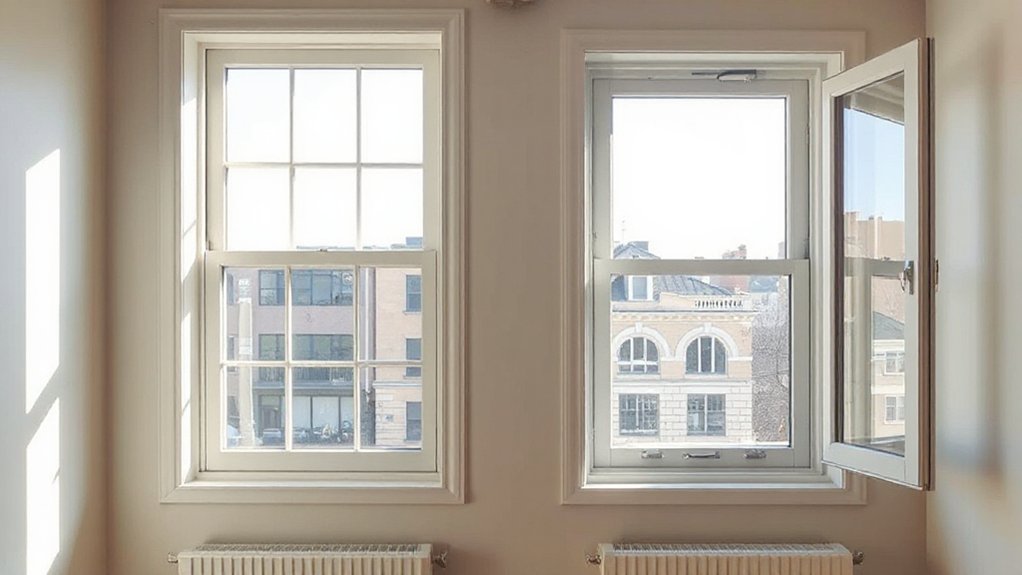
You’ll compare how noise is reduced across sash and casement designs by examining underlying Noise Reduction Mechanisms, frame sealing efficacy, and glass performance variants.
This discussion focuses on how frame joints, gasket quality, and glazing choices interact to lower airborne sound transmission.
Expect concise, quantitative criteria to gauge which configuration delivers the lowest sound levels in typical building conditions.
Noise Reduction Mechanisms
Noise reduction mechanisms for sash and casement windows rely on a combination of glazing, frame seals, and installation quality. You’ll measure performance by how well the system blocks airborne noise without compromising operability or daylight.
Key elements include glazing thickness, gas fills, and lamination, plus gasket profiles that seal perimeters under pressure. Proper alignment prevents rattle and flutter, delivering consistent sound attenuation across frequencies.
Materials chosen should respect historical authenticity while supporting modern performance, ensuring the product remains durable and aesthetically versatile.
Maintenance access matters: easy seal replacement sustains effectiveness. Climate considerations influence cavity depth and glazing options.
Here’s how to evaluate:
- Precise tolerances that minimize gaps
- Durable seals resisting thermal cycling
- Multi-layer glazing tuned to noise spectra
- Non-vibrating frames with stiffeners
- Aesthetic versatility preserving character
Frame Sealing Efficacy
How effective are frame seals at reducing sound transmission in sash versus casement configurations? Frame sealing efficacy hinges on gasket integrity, contact force, and airtight interfaces.
Sash windows typically rely on multiple seals around movable profiles, which can create layered cavities that dampen pressure differentials more consistently when closed.
Casement frames often use continuous gaskets along a single perimeter, reducing leakage paths but risking corner gaps if misaligned.
You’ll measure performance by surface finish, compression, and aging of seals, noting that degraded seals markedly raise transmission.
Consider color options and material choices, which influence durability, installation tolerances, and compatibility with frame materials.
For best results, select seals with low permeability, UV resistance, and stable compression across temperature ranges, ensuring uniform closure and minimizing mid-channel leakage.
Glass Performance Variants
Glass Performance Variants: different glass types provide variable sound attenuation due to their inherent stiffness, damping, and seal interactions. You’ll compare laminated, tempered, and low-emissivity options to gauge real-world outcomes, focusing on how each choice affects noise reduction without compromising daylight or security.
Your assessment weighs mass, interlayer composition, and edge seals, ensuring historical authenticity and aesthetic harmony remain intact in period-appropriate frames. Precision selection minimizes vibration coupling and transmission paths, preserving comfort in urban and rural settings.
- Laminated interlayers for higher STC without bulk
- Acoustic laminates preserving visual clarity
- Thermal coatings aligned with authentic finishes
- Edge sealing tuned to sash movement
- Bonded assemblies sustaining historical authenticity and aesthetic harmony
Cost and Value: Upfront Price to Long‑Term Worth
Upfront cost matters, but it’s only part of the picture. When you compare sash and casement windows, you weigh purchase price against long‑term worth.
Sash windows typically involve higher initial costs due to timber components, hardware, and precise fitting, yet they can offer lower maintenance if you select durable finishes and proper restoration strategies.
Casement units often come in lower upfront price bands, but potential long‑term expenses rise with hardware wear, seal degradation, and replacement glazing.
Evaluate energy performance, ventilation efficiency, and repairability as you project lifecycle costs.
Historical authenticity matters where you value period accuracy; Material sustainability matters when you prioritize eco‑friendly inputs and long‑lasting performance.
A prudent choice balances initial outlay with anticipated durability, maintenance needs, and energy savings over time.
Best Uses by Home Style: When to Choose Sash Windows Vs Casement
Sash and casement windows suit different architectural styles and practical needs, so choosing between them hinges on your home’s design language and typical room use. In this section, you weigh historical significance and architectural compatibility to guide selection based on style, scale, and function.
- Aligns with historic districts for authenticity and curb appeal
- Complements modern, minimal lines without visual clutter
- Enhances ventilation patterns in kitchens and baths
- Supports tall, airy rooms with sash’s clear sightlines
- Maintains energy performance across diverse facades
Choose sash when preservation or traditional detailing matters; opt casement for circulation, unobstructed views, and retrofit flexibility.
Frequently Asked Questions
Can Sash and Casement Windows Be Non-Wood Materials?
Yes, you can use non-wood materials. You’ll prioritize material durability and design aesthetics, selecting uPVC, aluminum, or composite frames. These choices offer low maintenance, weather resistance, and crisp lines while preserving performance and energy efficiency in sash and casement styles.
How Do Window Hinges Affect Ventilation Control?
Openness improves when hinges permit precise sash or casement travel, enabling better ventilation control. You’ll notice a window seal and hinge durability govern leakage and airflow; misalignment limits venting, while robust hinges sustain consistent, adjustable opening without rattling.
Are There Energy-Grade Differences by Region or Climate?
Regional insulation and climate impact create energy-grade differences by region or climate, influencing your heating and cooling needs. You’ll see variations in U-values, glazing, and frame materials, with harsher climates demanding higher insulation standards and tighter building envelopes.
Can Both Types Be Tilt-And-Clean for Second-Floor Access?
Yes, both sash and casement can be tilt-and-clean for second-floor access. You’ll use window cleaning techniques suited to each style, enabling second floor access while minimizing risk and maximizing reach, efficiency, and safety.
Do Rebates Apply Equally to Sash and Casement Upgrades?
Yes, rebates generally apply based on product category, but you must check regional policies; financial incentives vary by region and program, and sash versus casement upgrades may have different eligibility or limits depending on local regulations.
Conclusion
You’ve seen how Sash Windows Vs Casement trade blows on style, performance, and upkeep. In short, choose sash for heritage charm and balanced insulation; opt for casement when air sealing, cleaning ease, and modern efficiency matter most. Decide based on your home’s orientation, budget, and desired maintenance load. Think of this choice as a hinge between eras—your upgrade should neatly swing toward the option that keeps your comfort locked in while the look stays unmistakably you.
About the Author


