
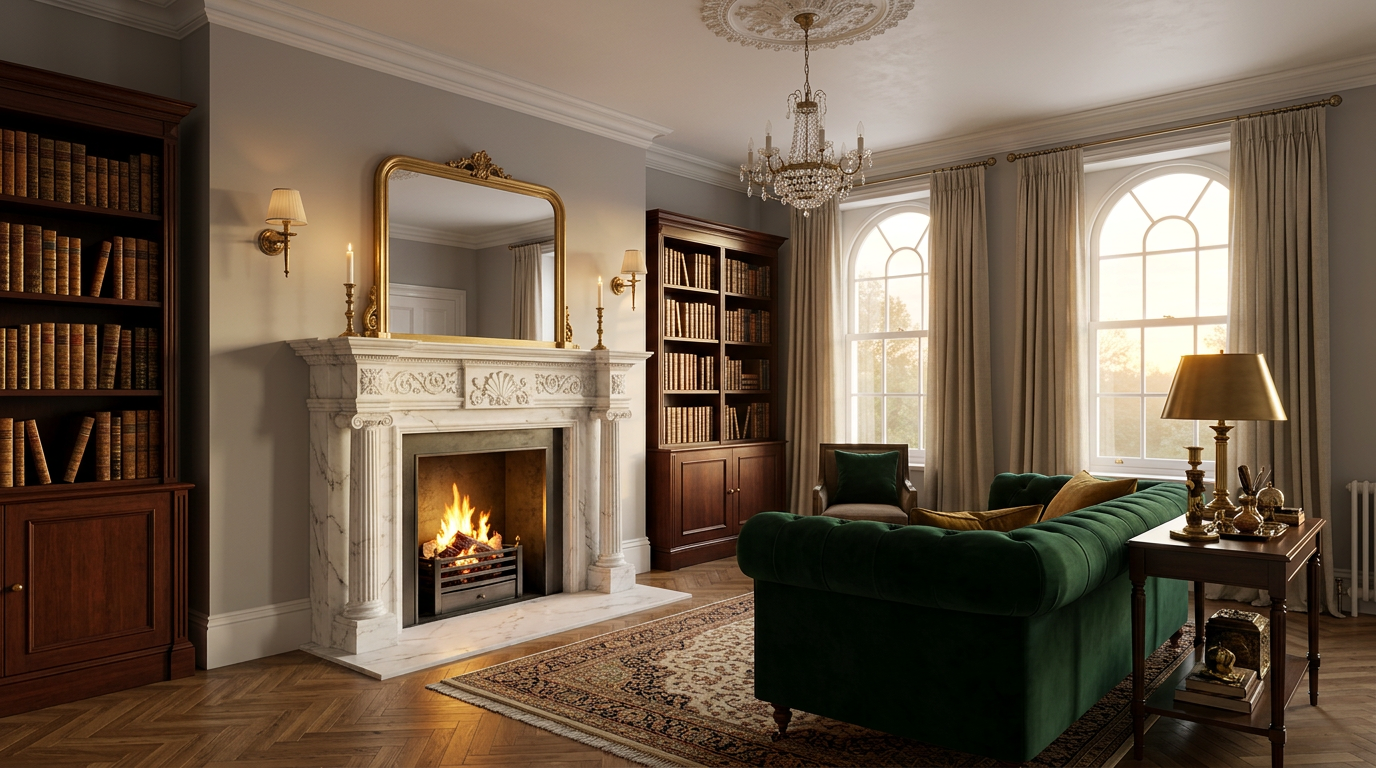
An antique fireplace mantel is one of the few period features that simultaneously enhances a room’s architectural character, adds measurable property value, and improves with age rather than deteriorating. This guide covers everything you need to know — from identifying periods and materials to assessing condition and getting the sizing right.
Key Takeaways
- “Mantel,” “surround,” and “overmantel” are distinct terms — understanding the difference helps when talking to salvage dealers and assessing what a piece includes.
- Marble is the prestige material, with Georgian and Regency marble mantels representing the finest examples of the domestic craft — and commanding the highest prices, from a few thousand to £20,000+ for attributed examples.
- Timber mantels are the most widely available and span the widest price range — from stripped pine at a few hundred pounds to quality mahogany or elaborate Victorian mirror overmantels at several thousand.
- Most antique mantels have been repaired — what matters is the quality of the repair, not its existence. Check corners, nosing edges, and changes of plane in marble; check joints and for woodworm in timber.
- Many salvage mantels are assembled from components of different origins — always ask whether all elements are original and contemporaneous with each other.
- Sizing is critical: take your fireplace opening dimensions and available wall space to any salvage dealer visit — a beautiful mantel that is the wrong scale for the room or the opening will not work however good it is in isolation.
- Period-appropriate placement adds the most value — a Georgian marble mantel in a Georgian room, or an Edwardian timber surround in an Edwardian house, is architecturally correct in a way that the antique market and period property buyers recognise and reward.
The fireplace mantel — the surround, shelf, and sometimes the full overmantel structure above a fireplace — is one of the most architecturally significant elements in any period room. It frames the fire, anchors the wall, and provides the focal point around which the rest of the room is composed. An antique fireplace mantel, bought and installed well, does something that no reproduction can fully replicate: it brings genuine material history into the room, and it does so in a way that improves with age rather than deteriorating from it.
This guide covers the main types of antique fireplace mantel, the materials they are made from, how to assess condition and value, and how to choose one that is right for both the building and the room.
What Is a Fireplace Mantel?
The term “mantel” (or “mantelpiece”) is used in several related but distinct ways. At its most basic, the mantel refers to the horizontal shelf above the fireplace opening. More broadly, it refers to the complete decorative structure framing the fireplace — the surround, which includes the two vertical side members (pilasters, jambs, or columns) and the horizontal member connecting them above the opening (the frieze or entablature), plus the shelf.
A full overmantel extends the structure further — a mirror, a series of shelves, additional decorative columns or pilasters, and a pediment or cornice above the mirror — creating a complete wall element rather than just a fireplace surround.
In the antique market, “fireplace mantel” typically refers to the surround and shelf as a unit, whether in marble, timber, stone, or cast iron, either with or without the overmantel.
Types of Antique Fireplace Mantel by Material
Marble Mantels
Marble is the prestige material for period fireplace mantels and the one most closely associated with Georgian, Regency, and early Victorian fireplaces of quality. A marble mantel in a well-preserved period interior is one of the most refined domestic objects available in the salvage market, and the finest examples — carved from Carrara white, Sienna yellow, or coloured statuary marble — represent a level of craft that modern alternatives at equivalent prices cannot approach.
Georgian marble mantels (c.1714–1830): The Georgian period produced the most restrained and architecturally rigorous marble mantels in the British tradition. Classical proportions — based on the orders of architecture, correctly interpreted — give Georgian marble mantels their characteristic sense of authority. The frieze may carry a central tablet with a carved motif (a classical figure, a patera, a swag of husks), the jambs are typically fluted columns or pilasters with carved capitals, and the shelf is precisely profiled in a classical moulding.
The finest Georgian marble mantels were designed by named architects — Robert Adam, William Chambers, Sir John Soane — and produced by specialist marble firms. Their quality is immediately apparent in the precision of the carving, the refinement of the proportions, and the quality of the marble itself.
Regency marble mantels (c.1811–1830): Lighter and more elaborate than the strictest Georgian work, with a greater willingness to introduce Egyptian, Greek, and Roman motifs in a more playful combination. Ormolu (gilt bronze) mounts are sometimes used to decorate the marble surface — a characteristically Regency combination of materials.
Victorian marble mantels: The Victorian period used marble across a wider social range than any previous era, and the quality varies accordingly. The finest Victorian marble mantels — commissioned for grand town and country houses — are superb examples of the marble worker’s craft. The most standard — produced in quantity for middle-class terraces — are competent but less refined. The characteristic Victorian combination of a black or dark marble inner slip (the trim immediately surrounding the fire opening) with a white, veined, or coloured outer surround is instantly recognisable and widely available.
What to look for: Marble mantels are graded by the quality of the marble itself (veining, colour, consistency), the quality of the carving (depth, precision, detailing), and the overall proportional refinement. Repairs are common — chips, cracks, and missing sections in marble are repaired with tinted epoxy fillers, and a skilled repair is difficult to spot. Look carefully at corners, nosing edges, and changes of plane for evidence of previous damage.
Timber Mantels
Timber mantels span the widest stylistic range of any material and are found in period properties from the seventeenth century through to the twentieth. They were used in secondary reception rooms and bedrooms where marble was not specified, and in houses at the middle and lower end of the housing market where marble was not affordable.
Pine mantels are the most common and the most commonly painted. A pine mantel that has been stripped of its paint coats — sometimes many layers accumulated over 150 years — can reveal attractive natural grain. More significantly, stripping reveals the quality of the carving and moulding beneath, which is frequently better than the paint-encrusted surface suggests.
Mahogany mantels were the standard choice for better-quality timber work in the Georgian and early Victorian periods. Mahogany’s dark, close-grained character gives a mantel weight and richness that pine cannot achieve. Many mahogany mantels survive in good condition — mahogany is more stable than pine and less prone to movement and splitting.

Oak and walnut were used for mantels in houses with a deliberately historic or artistic character — the Arts and Crafts movement in particular specified oak for its associations with English vernacular architecture and craft tradition.
Victorian timber overmantels: The most elaborate timber mantel form is the high Victorian mirror overmantel — a complex structure of turned columns, shelves at different heights, a large central mirror (often with a deep bevelled frame), and a pediment or broken pediment above. These were standard in middle-class Victorian parlours and dining rooms, and they survive in large numbers. In good condition, they remain impressive objects. Their scale — typically 2.4–2.7 metres in total height — makes them imposing in any room with adequate ceiling height.
Slate and Stone Mantels
Slate was used extensively as an affordable alternative to marble from the mid-Victorian period onward. Many slate mantels were painted or marbled (decorated with paint to resemble veined marble — a craft tradition known as faux marbling), and stripped examples reveal attractive grey-blue natural slate beneath.
Stone mantels — in limestone, sandstone, or reconstituted stone — are associated with grander country houses and ecclesiastical buildings rather than the typical urban terraced house. A limestone mantel of good quality has a warmth and solidity that marble does not always possess, and it sits naturally in buildings of stone construction.
Cast Iron Mantels
The full cast iron mantel — where the surround, pilasters, and shelf are all cast in iron as a single architectural unit — is relatively uncommon but does appear in the Victorian period, particularly in smaller rooms and kitchens where a fully integrated, durable, and low-maintenance piece was specified. More commonly, cast iron forms the insert (the register grate unit) within a marble or slate surround rather than the complete mantel structure.
How to Assess an Antique Fireplace Mantel
Proportion and Design Quality
The most important determinant of quality in any antique mantel is the quality of the original design — the proportional refinement that distinguishes a piece designed with architectural understanding from one produced to a standard pattern. This is partly a matter of training the eye over time, but specific indicators include:
- The relationship between shelf width and height: a mantel that is too tall for its width looks awkward; one too low for its width looks unresolved
- The quality of classical detail: correctly proportioned column capitals, precisely cut moulding profiles, a frieze that is in proportion to the jambs below
- The refinement of transitions: the junction between jamb and frieze, the profile of the shelf nosing, the treatment of the inner slip edge
A mantel with good proportions and well-resolved detail will look right in a room in a way that is difficult to articulate but immediately apparent.
Condition
Marble: Look for chips, cracks, staining, and previous repairs. The inner slip (around the fire opening) is particularly vulnerable to heat damage and physical impact. Surface staining — smoke, mineral deposits, cleaning product damage — can sometimes be addressed by specialist stone cleaning but is sometimes irreversible. Previous repairs should be assessed for quality rather than avoided outright.
Timber: Woodworm is the most common timber mantel defect — look for flight holes (small round exit holes in the surface) and for active infestation (fine powder below holes). Historic woodworm that has been treated is not a structural concern; active infestation requires treatment before the piece is installed. Check joints and connections for looseness — Victorian overmantel units in particular can loosen at their many joints over time. Missing sections of carved detail can sometimes be replaced by a skilled carver but add restoration cost.
Slate: Examine for cracks (particularly across the shelf) and for delamination of the surface (slate is a layered material and can split in thin surface layers with age and thermal cycling). Paint layers on a slate mantel conceal both defects and potential quality — stripping to assess condition beneath is worth doing before purchase if the dealer permits it.
Originality of Components
Many antique mantels have been assembled from components of different origins — a Georgian shelf on a Victorian surround, a replaced inner slip, a later carved detail substituted for a missing original. This is not necessarily a disqualification, but it affects value and should be disclosed by a reputable dealer. Ask specifically whether all components are original to the piece and contemporaneous with each other.
Sizing an Antique Mantel for Your Fireplace Opening
The practical challenge in buying an antique mantel is matching its dimensions to the fireplace opening in your building. The key measurements are:
Opening width and height: The clear dimensions of the fire opening itself. The inner slip or insert must be sized to contain this opening.
Surround width: The overall width of the mantel from outer edge of jamb to outer edge of jamb. This must relate to the wall space available — a mantel that is too wide for its wall looks cramped; one too narrow looks lost.
Shelf projection: How far the shelf projects from the wall. A shelf that projects too far is a practical hazard; one that projects too little provides insufficient display space.
Overall height: The height from hearth level to the top of the shelf. In a room with a standard 2.4 metre ceiling, a mantel shelf height of 1.1–1.2 metres is typical. A full overmantel must be assessed against ceiling height — an Edwardian overmantel at 2.5 metres requires at least a 2.7 metre ceiling to sit comfortably.
Salvage dealers will provide dimensions for any specific piece. Take the dimensions of your existing opening and the available wall space to any dealer appointment.
Installation Considerations
Installing an antique fireplace mantel is a combination of building work (securing the surround to the wall, connecting to the flue if the fireplace is to be used as a working fire) and skilled finishing work (making good the plasterwork around the mantel, connecting the hearth, and finishing any gaps or irregularities).
For a non-working decorative installation, the work is relatively straightforward — the mantel is secured to the wall and the hearth material is laid. For a working fire, the fire opening must connect to a functional flue, which may require installation of a flue liner (particularly in older buildings where the original flue has deteriorated or where the original fire size does not match the antique piece being installed). This is work for a HETAS-registered installer who can certify the installation under current Building Regulations.
The Value Proposition
An antique fireplace mantel in a period property is one of the few original features that simultaneously enhances the architectural character of the room, adds measurable value to the property, and provides a focal point that no modern alternative can replicate.
Prices in the salvage market range from a few hundred pounds for a standard pine Victorian mantel requiring restoration to several thousand for a fine Georgian or Regency marble mantel in good condition. Georgian marble mantels of high quality can reach £5,000–£20,000 or more at specialist auction, depending on provenance, design attribution, and condition.
For buyers of period property, the presence of original mantels — or of well-chosen period-appropriate antique replacements — is a quality signal that sophisticated buyers recognise and respond to. A restored antique mantel is not a luxury; in a period house, it is the correct feature for the room, and everything else is a compromise.
About the Author


