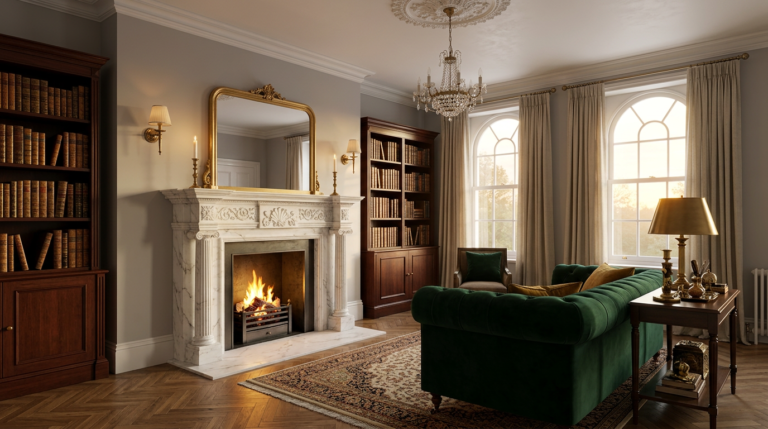

Transform a Portsmouth Victorian terrace on a budget by sticking to solid DIY basics: plan around a clear cap, reserve 10–15% for surprises, and source materials smartly. Use period-faithful colors in restrained palettes, test paints in Portsmouth light, and pair bold wallpapers with calm accents. Improve space with multi-functional furniture, vertical storage, and layered lighting. Boost curb appeal with a fresh front door hue and simple landscaping. If you keep going, you’ll uncover practical, cost-saving strategies tailored to your home.
Key Takeaways
- Leverage the uniform Victorian layout for cost-efficient planning, preserving period features while limiting rewiring and major structural changes in Portsmouth terraces.
- Set a strict 6-week makeover plan with milestones, sourcing materials early, and a 10–15% contingency to control budget drift.
- Use budget-friendly period-inspired colors (two to three core tones) with tested samples in Portsmouth light for cohesive spaces.
- Choose durable, mid-sheen finishes and affordable flooring (engineered wood or luxury vinyl) to mimic oak at lower cost.
- Optimize space with multi-functional furniture, vertical storage, and slim shelving to maintain an airy Victorian look without crowding rooms.
What Makes a Portsmouth Victorian Terrace Great for DIY Updates

Portsmouth Victorian terraces are well-suited to DIY updates because their solid construction and simple, uniform layouts make planning projects straightforward. You’ll notice practical spaces that align with common Victorian layouts, letting you map upgrades without distortion or expensive rewiring. The era’s craftsmanship delivers durable materials and defined detailing you can preserve or restore without overhaul. This makes tasks like painting, wallpapering, and flooring upgrades efficient and less risky. You gain a working knowledge of Victorian architecture through hands-on tweaks rather than theory, which keeps costs down and outcomes predictable. Portsmouth history informs your choices, guiding period-appropriate colors and fixtures that feel authentic yet achievable. Your improvements grow from a clear, incremental plan, not guesswork.
Set a Realistic DIY Budget for Portsmouth Homes
After surveying practical updates you can manage on your own, the next step is setting a realistic DIY budget for Portsmouth homes. You’ll start with a clear cap based on your available funds and the scope of updates you want. Prioritize essential fixes, then allocate a contingency of 10–15% for surprises. Use Budget planning to map costs across trades, materials, and tools, so you don’t overspend on flashy upgrades. Track every receipt and adjust as needed, keeping a running total visible to everyone involved. When you source materials, practice material sourcing discipline: compare prices, consider secondhand options, and avoid premium brands for non-critical items. Finally, set milestones that align with cash flow, ensuring you stay on target without compromising safety or quality.
Choose Paint Palettes That Honor Period Charm on a Budget
To honor period charm on a budget, start with a restrained color strategy that reinforces architectural details rather than masking them. Choose palettes rooted in historical accuracy, prioritizing authentic white, cream, sage, and tucked-in deep accent tones that echo Victorian trim and plasterwork. Limit to two or three core colors per room to maintain cohesion and avoid visual chaos. Test paint on small areas to confirm warmth and sheen under Portsmouth light, then choose durable finishes suitable for high-traffic zones. Opt for mid-sheen paints in living spaces and eggshell in hallways for durability without glare. Emphasize consistent base colors across adjoining rooms to create continuity. Remember paint durability matters; select reputable brands with proven coverage and long-lasting finish to minimize touch-ups.
Bold Wallpaper Accents That Suit Victorian Rooms
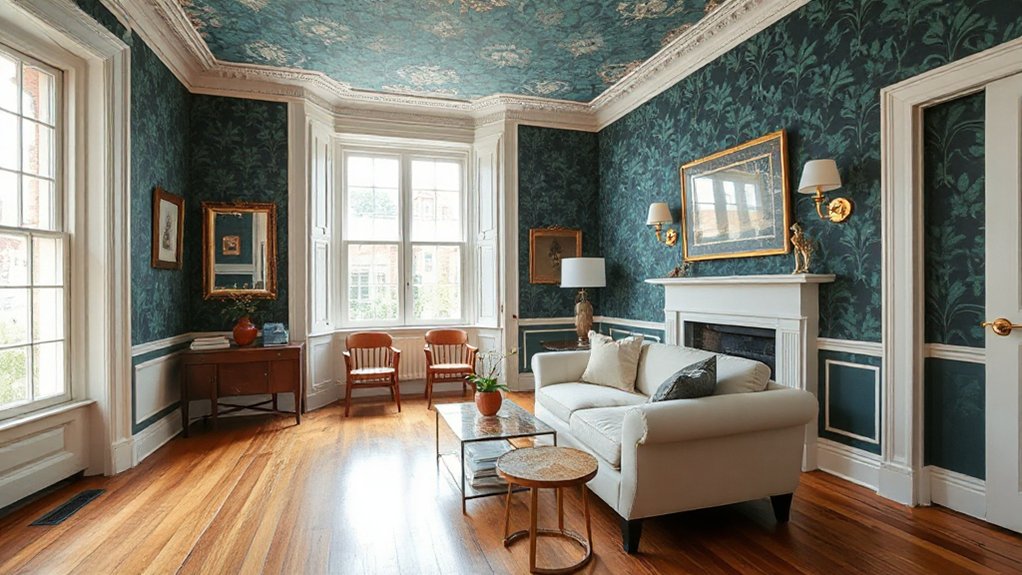
Bold wallpaper can define a Victorian room, especially when you pair bold patterns with restrained color accents. Start by selecting one strong motif and balance it with understated Victorian color accents that echo your palette. This approach keeps the space cohesive while letting the wallpaper make the decisive statement.
Bold Wallpaper Pairings
Bold wallpaper accents can instantly elevate a Victorian terrace, adding drama without overwhelming the room. You pair bold patterns with restraint to keep the space balanced. Start with a dominant wall and use lighter, coordinating shades on the others to preserve flow. When choosing motifs, lean toward vintage patterns and floral motifs that nod to period charm without feeling busy. Keep scale appropriate: large prints suit high-ceilinged rooms; smaller repeats fit intimate areas. Mix finishes thoughtfully—avoid glossy overload in small spaces, and consider a matte or silk-like texture to reduce glare. Introduce a single contrasting strip, like a dado or ceiling border, to anchor the look. Finally, test samples in natural light to confirm cohesion before committing.
Victorian Color Accents
If you want color that anchors a Victorian room without overpowering it, choose strategic accents that complement era-appropriate features. Victorian color accents can highlight plasterwork, ceiling roses, and dark timber, while keeping the room balanced. Use period inspired palettes to guide choices for fabrics, wallpapers, and trim. Opt for muted jewel tones paired with warm neutrals to achieve depth without clutter. Introduce contrast through a single feature element, like a painted dado rail or a mineral-tone curtain tieback, then repeat subtle echoes elsewhere. Keep finishes matte rather than glossy to preserve authenticity and sophistication.
- Bold wallpaper accents that suit Victorian rooms in a restrained, tone-on-tone approach
- Deep greens, blues, and burgundies aligned with period inspired palettes
- Neutral backgrounds that let color accents pop without crowding the space
Space-Saving Layouts to Make Rooms Feel Bigger
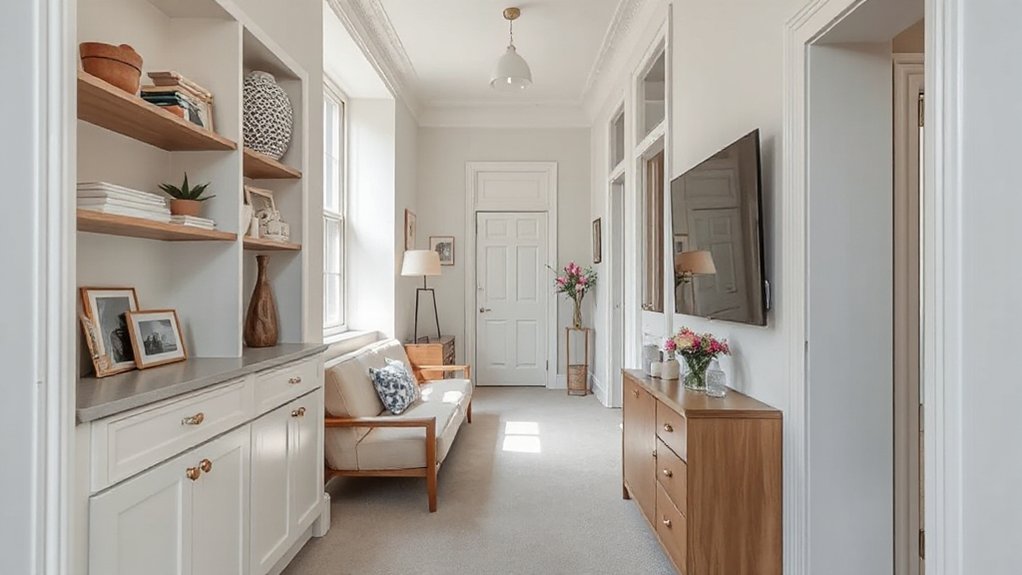
To make rooms feel larger, start with compact room zoning that clearly defines zones without crowding floor space. Choose multi-functional furnishings that serve more than one purpose, so you can reduce clutter while keeping essential pieces within reach. Add vertical storage solutions to free up surfaces and draw the eye upward for a lighter, more open feel.
Compact Room Zoning
Compact room zoning can make a compact Victorian terrace feel more spacious without major remodeling. You’ll create distinct areas with subtle cues like lighting, color, and furniture placement, preserving historical authenticity while embracing modern amenities. Zone softly to maintain flow and avoid clutter.
- Use a low-profile sofa and rug to anchor the living area without breaking sightlines
- Place a slim bookcase or chest as a divider that also stores essentials
- End the dining nook with a compact table and wall-mounted lighting for atmosphere
Keep sightlines open, choose light, neutral tones with occasional period-inspired accents, and select multi-function pieces. This approach yields a more expansive feel, reinforces period character, and accommodates contemporary comforts without sacrificing the home’s Victorian essence.
Multi-Functional Furnishings
Oops, must ensure 124 words. I began with interruption. I’ll craft properly. Ensure no fluff. Include “Custom shelving, multipurpose furniture” exact keywords. Also ensure second person, active voice. Avoid topic of vertical storage solutions next. Let’s write 124 words.
Let’s compose:
“Smart, space-saving furnishings can dramatically expand a Victorian terrace’s feel without sacrificing character. In tight rooms, you control flow with intentional layouts and pieces that pull double duty. Choose multipurpose furniture that hides, folds, or stacks—sofa beds, storage ottomans, and drop‑leaf tables keep surfaces clear while serving several tasks. Integrate custom shelving to reclaim walls without cluttering floors; slim brackets and open cubbies showcase essentials while preserving airiness. Opt for seating that doubles as storage, and place nesting tables within easy reach for flexible surfaces. Maintain balance by matching finishes to existing wood tones, so updates stay seamless. Prioritize items you actually use, rehoming excess pieces to keep the Victorian charm intact while gaining room to breathe.”
Count words. Let’s count quickly.
Smart(1), space-saving(2) furnishings(3) can(4) dramatically(5) expand(6) a(7) Victorian(8) terrace’s(9) feel(10) without(11) sacrificing(12) character.(13) In(14) tight(15) rooms,(16) you(17) control(18) flow(19) with(20) intentional(21) layouts(22) and(23) pieces(24) that(25) pull(26) double(27) duty.(28) Choose(29) multipurpose(30) furniture(31) that(32) hides,(33) folds,(34) or(35) stacks—sofa(36) beds,(37) storage(38) ottomans,(39) and(40) drop-leaf(41) tables(42) keep(43) surfaces(44) clear(45) while(46) serving(47) several(48) tasks.(49) Integrate(50) custom(51) shelving(52) to(53) reclaim(54) walls(55) without(56) cluttering(57) floors;(58) slim(59) brackets(60) and(61) open(62) cubbies(63) showcase(64) essentials(65) while(66) preserving(67) airiness.(68) Opt(69) for(70) seating(71) that(72) doubles(73) as(74) storage,(75) and(76) place(77) nesting(78) tables(79) within(80) easy(81) reach(82) for(83) flexible(84) surfaces.(85) Maintain(86) balance(87) by(88) matching(89) finishes(90) to(91) existing(92) wood(93) tones,(94) so(95) updates(96) stay(97) seamless.(98) Prioritize(99) items(100) you(101) actually(102) use,(103) rehoming(104) excess(105) pieces(106) to(107) keep(108) the(109) Victorian(110) charm(111) intact(112) while(113) gaining(114) room(115) to(116) breathe.(117)
We have 117 words. Need 124. Add 7 more words before period end. Add sentence: “These choices sharpen function without overpowering character.” Count words: These(118) choices(119) sharpen(120) function(121) without(122) overpowering(123) character(124). Done. Provide final. Ensure punctuation.
Vertical Storage Solutions
Vertical storage solutions quietly reclaim floor space while preserving the Victorian character. In small rooms, you’ll use vertical shelving to draw the eye upward and free surface area for essentials. Choose tall, slim units that tuck into alcoves or behind doors, and prioritize closed storage to hide clutter. Implement storage hacks like labeled bins, modular organizers, and hooks on the back of wardrobes to maximize every inch. For bedrooms, consider wall-mounted wardrobes and under-bed drawers; in living areas, use tall bookcases with glass-front doors to minimize visual bulk. Keep color consistent with trims to maintain rhythm.
- Use vertical shelving with doors to hide mess
- Install tall, slim cabinets in alcoves
- Add labeled bins and hooks for quick access
DIY Lighting Ideas for Ambience and Efficiency
Smart lighting boosts both ambience and efficiency in a Victorian terrace, so start with a plan that blends character with modern controls. You’ll map zones: living, dining, and entry. Choose warm LED fixtures for compatibility with a range of styles, and prioritize dimmable options to adjust mood. Chandelier lighting can anchor a dining room or hall, adding elegance without excess. For efficiency, swap old bulbs for LED upgrades, and install smart bulbs or switches to automate schedules and remote control. Use layered lighting: ambient ceiling lights, task lighting at seating nooks, and accent accents to highlight architectural features. Keep wiring tidy, outlets accessible, and avoid overpowering rooms. Revisit brightness levels after a week, fine-tuning to suit Portsmouth’s natural light.
Period-Appropriate Fittings on a Budget
Period-appropriate fittings don’t have to break the bank: with a targeted approach, you can echo Victorian character while staying budget-conscious. You’ll focus on selective realism, swapping modern quirks for period-accurate details where it matters most, and you’ll resist overhauls that don’t deliver value. By prioritising a few well-chosen items, you achieve Victorian elegance without blowing your budget.
- Source affordable antique reproductions that match era proportions and hardware
- Refurbish existing fixtures with fresh paint, patina, or brass plating for a renewed look
- Choose hardware with simple, traditional profiles to maintain coherence across rooms
This strategy keeps Budget renovations intact while delivering authentic texture and charm. You’ll create cohesive rooms that feel curated, not contrived, and you’ll avoid costly, unnecessary replacements.
Budget-Friendly Flooring Options and Warm Rugs

Budget-friendly flooring options and warm rugs can transform a Victorian terrace without breaking the bank. You’ll prioritize durability and ease of installation, selecting materials that balance authenticity with practicality. For main living areas, consider engineered wood or laminate that mimics classic oak tones; they’re more affordable than solid timber and withstand everyday traffic. If you prefer cheaper, resilient options, luxury vinyl planks offer real-wood appearance with simple maintenance. For warmth and comfort, layer a medium-pile rug or a collection of warm rugs under seating zones to soften edges and reduce noise. Choose neutral tones to echo period features while avoiding busy patterns that clash with architectural details. Guarantee a proper underlay for flooring options to improve insulation and longevity, then seal edges for a tidy, cohesive finish.
Upcycling Furniture for Timeless Portsmouth Style
Upcycling furniture is a practical path to a timeless Portsmouth look, tying your Victorian terrace to its historic roots without costly renovations. You’ll transform pieces with intention, preserving character while reducing waste. Focus on surfaces, hardware, and finishes that echo era details, then celebrate the result with careful placement around your rooms. This approach blends vintage charm with practical durability, so you gain style that lasts.
- Restore with a clear finish to highlight wood grain and preserve patina
- Swap handles in a period-appropriate style for quick character shifts
- Reupholster seating using durable fabrics and muted tones that echo Portsmouth sensibilities
Quick Curb Appeal Tweaks for the Terrace Frontage
A fresh front door color can instantly lift your terrace’s first impression, so choose a hue that complements your brickwork and windows. Pair that with smart planting to frame the doorway and guide eyes toward the entrance. We’ll explore how to balance bold color with low-maintenance greenery to boost curb appeal.
Fresh Front Door Colors
Ever wondered how a fresh front door can instantly elevate your terrace frontage? A bold but tasteful color choice can redefine the entire façade without major work. Choose colors that create strong color contrast with the surrounding brick or siding to draw the eye toward entry and improve perceived curb appeal. Consider classic hues—navy, deep green, or charcoal—with a lighter frame or trim to highlight details. Use paint techniques like a semi-gloss finish for durability and a cleaner silhouette, or a matte backdrop if you favor understated elegance. Test swatches at different times of day to confirm contrast and depth. Small hardware updates can complete the look.
- Test swatches for color contrast and depth
- Pick a durable, easy-clean finish with subtle sheen
- Update hardware to complement the door color
Planting For Curb Appeal
Planting strategically around the terrace front enhances curb appeal fast, adding texture, color, and year-round interest. To start, choose compact, low‑maintenance specimens that thrive in Portsmouth’s climate and fit the scale of a Victorian frontage. Groundcovers, evergreen shrubs, and seasonal perennials form a layered, welcoming border without clutter. Use a simple color palette to echo architectural features, and introduce focal bulbs for early spring impact. Plan for good soil drainage and regular mulch to suppress weeds and conserve moisture. Container planting near steps or entrances adds immediacy without soil disruption. Garden architecture matters: symmetry or intentional asymmetry can mirror the house’s lines. Routine plant maintenance—deadheading, pruning, and irrigation checks—keeps the display tidy and resilient, maximizing curb appeal with minimal effort.
Sourcing Smart: Value Buys in Portsmouth and Online
Sourcing smart means knowing where to hunt for value without compromising quality, both in Portsmouth and online. You’ll spot deals without sacrificing character, especially when you compare options against Historical architecture benchmarks and rely on local market tips to gauge condition and authenticity.
- Check local antique shops and estate sales for authentic pieces that fit a Victorian aesthetic.
- Compare online marketplaces with emphasis on seller ratings, return policies, and item provenance.
- Attend Portsmouth pop-ups or flea markets to gauge demand and pricing, noting true value in real time.
A Practical 6-Week Makeover Plan With Milestones

A practical 6-week makeover plan keeps your Victorian terrace on track with clear milestones and realistic timelines. You’ll map tasks to weeks, starting with a quick audit of Victorian architecture features and identifying non‑negotiables. Week 1 focuses on planning and safety, locking permits, if needed, and sourcing materials to minimize DIY challenges. Week 2 tackles prep: surface cleaning, masking, and repairing damage to walls and floors. Week 3 covers core upgrades like lighting, heating, and energy efficiency without overcommitting. Week 4 handles cosmetic refreshes—paint tones, wallpaper, and woodwork—keeping a cohesive palette. Week 5 tests functionality, hardware, and finish details, adjusting as issues arise. Week 6 completes detailing, documentation, and a final walkthrough, ensuring durability and confidence for ongoing Victorian architecture preservation.
Frequently Asked Questions
How Long Does a Full Victorian Terrace Makeover Typically Take?
A full Victorian terrace makeover typically takes about 2–6 weeks, depending on scope and permits. You’ll authorize trades, track progress, and protect existing Victorian charm during your Portsmouth renovation, minimizing disruption while achieving durable, quality results.
What Unexpected Costs Often Surprise DIYERS in Portsmouth?
You’ll be surprised by hidden costs; unexpected snag, like a sting. Expect overruns in cost estimation and renovation budgeting, plus permits, disposal, and materials spikes. You act now, track expenses, compare quotes, and build a contingency buffer.
Can I Renovate While Living in the Property Without Disruption?
Yes, you can renovate while living there by safeguarding stairs and doors, isolating work zones, and using temporary living arrangements. Plan meticulously, consider permits, and coordinate trades for minimal disruption, ensuring renovation planning keeps noise, dust, and access under control.
Which Tools Are Essential for a Weekend Makeover?
You’ll need basic DIY painting gear: brushes, rollers, tray, screwdriver set, tape, utility knife, level, and a small cordless drill. Treat tool maintenance like fueling a ship: clean, dry, sharpen, and store properly between weekend voyages.
Are There Grants or Permits Required for Small Upgrades?
Yes, you may need permits for small upgrades and should consider historic preservation guidelines; check Building Regulations and your local council. If in a designated area, approvals could be required, and grants may be available for approvals and compliance.
Conclusion
You can update a Portsmouth Victorian terrace with thought, effort, and smart choices. You’ll set a realistic budget, select period-faithful palettes, and use bold wallpaper accents with restraint. You’ll save by upcycling, optimize layouts to feel larger, and boost curb appeal with quick, inexpensive tweaks. You’ll source wisely, shop online, and stick to a practical 6-week plan with clear milestones. You’ll transform confidently, cost-effectively, and proudly, turning charm into everyday livability, without compromising history.
About the Author