
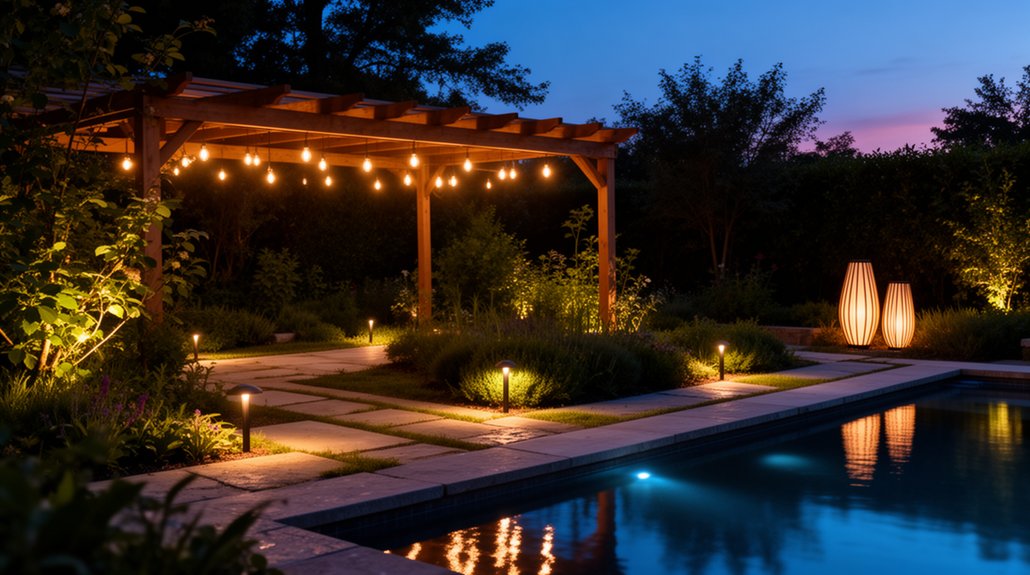
Garden lighting trends for 2025 center on cinematic layering, smart controls, and color-tuned fixtures that turn outdoor spaces into mood-driven environments while prioritizing safety and energy efficiency. You’ll blend ambient, task, and accent lighting to sculpt depth, highlight architecture, and stage water features with synchronized effects. Consider solar, low-voltage, or line-voltage power, plus scalable controls for scenes and climate-adaptive adjustments. Ready for real-world layouts and upgrade priorities that elevate curb appeal and performance. More insights await.
Key Takeaways
- Layered lighting with ambient, task, and accent layers remains essential for mood, depth, and navigation in 2025 garden spaces.
- Color-tunable and bi-color LEDs will enable seasonal shifts and plant texture enhancement with smarter scene control.
- Solar and low-voltage options continue to rise for sustainable, easier installations with safer wiring and maintenance benefits.
- Smart controls, automation, and occupancy/weather-responsive adjustments will synchronize indoor-outdoor lighting scenes across zones.
- Durable, weatherproof fixtures with glare control and modular design will support long-term performance and future-proof upgrades.
Cinematic Garden Lighting Defined: Framing the 2025 Plan

Cinematic garden lighting defines outdoor spaces by treating illumination as a narrative device—layering key accents with strategically softened backgrounds to guide the eye and set the mood. You frame your 2025 plan around intent, not just fixtures, prioritizing effect over volume. You map contours, pathways, and focal plants, using luminance hierarchy to reveal structure in darkness. You align color temperature with plant textures and seasonal shifts, ensuring consistency across zones. You consider maintenance cycles, durability, and energy efficiency to sustain a refined look year-round. You assess garden pests and soil nutrients to avoid lighting-induced surprises, choosing fixtures that minimize glare on foliage while supporting healthy growth. You document metrics for performance, ensuring your cinematic strategy translates into measurable curb appeal and experience.
Foundations of Cinematic Lighting: Layering Ambient, Task, and Accent
Layered lighting forms the backbone of cinematic outdoor design, balancing ambient, task, and accent to shape mood and function. You’ll deploy ambient glow for atmosphere, task light for navigation and activity, and targeted accents to sculpt texture and focal points. Mastery comes from coordinating these layers with scales, contrast, and color temperature to create depth without glare.
Layered Lighting Principles
To create depth and functionality in outdoor spaces, you combine ambient, task, and accent lighting into a cohesive layering strategy. Layered lighting principles guide you to place broad, diffuse illumination for safety and atmosphere, then add focused task lighting where you perform activities, and finish with selective accents to sculpt texture and drama. You balance brightness, color, and direction, ensuring progressions between zones feel seamless rather than jarring. Consider sightlines, glare control, and maintenance access as you plan, so cycles of use aren’t interrupted. This approach supports wildlife attraction by avoiding harsh, glaring beams while highlighting pathways and plant details without overstimulation. It also respects plant growth, safeguarding blooms from heat or photoperiod stress while preserving natural silhouettes in the landscape. Your scheme becomes adaptable, resilient, and quietly powerful.
Ambient, Task, Accent Roles
Ambient, task, and accent lighting each play a distinct, indispensable role in cinematic outdoor illumination. You design a cohesive scheme by layering these roles to guide visitors, highlight features, and control mood with precision. Ambient lighting provides broad, even base illumination that enhances safety and atmosphere without overpowering focal points. Task lighting delivers function where you need it—paths, steps, seating areas—so you can move confidently after dusk. Accent lighting carves drama by sculpting textures and architectural cues, drawing attention to plant forms, foliage silhouettes, and water features. In practice, balance is key: keep garden pests from becoming distractions by shaping light spill, and plan for plant pruning to maintain the intended silhouettes. This framework supports consistent, publish-ready outdoor spaces.
Cinematic Outdoor Techniques
Cinematic outdoor lighting hinges on purposeful layering: you combine ambient, task, and accent to sculpt mood, guide movement, and reveal landscape details with cinema-grade clarity. You’ll apply layering to foreground features, pathways, and focal trees, ensuring transitions feel natural and purposeful. Use low-angle ambient to wash large areas, targeted task to illuminate seating, and precise accent to highlight textures and garden elements, including soil health cues. Keep color temperature calibrated to blend with dawn or dusk tones, preserving soil and plant hues. Track how pests affect plant health and adjust lighting to minimize glare that stresses crops. Plan for seasonal pest activity and light pollution control to protect beneficial insects and soil biology.
- Layering strategy
- Pathway illumination
- Focal texture accents
- Seasonal pest management
Power Choices for Outdoor Lighting: Solar, Low-Voltage, or Line-Voltage
Solar power lowers your footprint and simplifies installs, but you’ll weigh battery support and sun exposure to guarantee year-round performance. Low-voltage wiring offers safer, reliable runs with flexible routing and fewer trenching requirements, making it a practical mid-range choice for most landscapes. Line-voltage brings full power and brightness where you need it, yet it demands careful planning, dedicated circuits, and stricter safety considerations.
Solar Footprint Considerations
When choosing power options for outdoor lighting, you’ll weigh solar, low-voltage, and line-voltage deployments against site needs, energy goals, and long-term maintenance.
- Solar footprint: assess daylight hours, panel efficiency, and storage to guarantee reliable nighttime performance without grid hookup.
- Eco friendly design: prioritize components with recyclable materials, minimal embodied energy, and non-toxic finishes.
- Reliability vs. budget: compare warranty, maintenance cadence, and expected lifespan to balance upfront costs with long-term value.
- Site impact: consider shade patterns, roof proximity, and ground surface to optimize placement and avoid glare.
In practice, solar nudges you toward autonomy and low ongoing costs, but confirm weather resilience and seasonal variance for consistent ambiance.
Low-Voltage Wiring Benefits
Low-voltage wiring delivers a dependable balance of safety, efficiency, and control for outdoor lighting. You’ll appreciate simpler installation and fewer trenching requirements compared to line-voltage setups, which reduces landscape disruption. With low voltage, you gain reliable, dimmable illumination that can be scaled to fit pathways, accents, and entryways without overloading circuits. Choose proper transformer sizing and weatherproof components to maintain consistent performance year-round. From a horticultural perspective, safer wiring minimizes soil disturbance, supporting soil health during installation. Garden pests are less likely to damage discreet cables when routing is planned with mulch beds and plant borders in mind. Maintain routine checks for moisture ingress and corrosion; these small habits preserve longevity and prevent outages that could compromise nighttime security and curb appeal.
Line-Voltage Power Tradeoffs
Line-voltage offers straightforward, scalable lighting power with fewer components than low-voltage systems, but it comes with higher energy, trenching, and safety considerations. You weigh its reliability against installation burden, long-term costs, and accessibility for upgrades. In practice, line-voltage boosts brightness consistently, supports larger spans, and reduces transformer clutter, yet demands trained electricians and careful zoning. You’ll need to balance landscape aesthetics with practical constraints, ensuring wiring is concealed and compliant. For plant health, daytime-ready options and shaded areas influence fixture placement, while color rendition affects perceived vibrancy. Your decision hinges on durability, serviceability, and total project scope. Consider these points:
- System scale and future-proofing
- Electrical code compliance and safety
- Aesthetics integration with landscape features
- Long-term maintenance and accessibility
Smart Controls for Personalized Outdoor Evenings
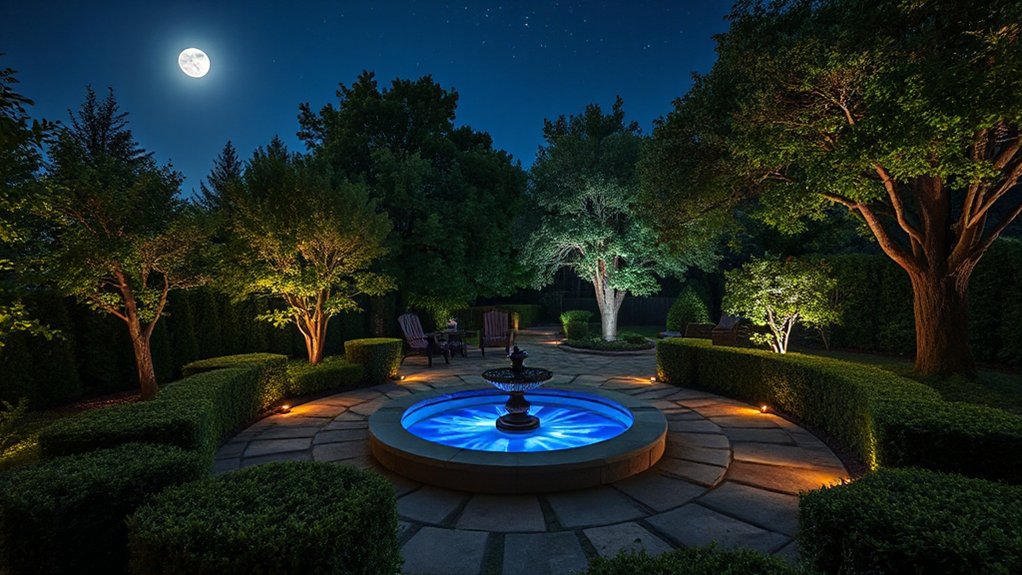
Smart controls empower personalized outdoor evenings by tailoring lighting scenes to your routines and moods in real time. You’ll benefit from intelligent timers, geo-fencing, and scene presets that switch as you move through patios, paths, and seating zones. System-aware sensors adjust brightness and color temperature to conserve energy while preserving ambiance. Integrations with smart speakers and outdoor hubs let you command lighting without stepping outside. In practice, you’ll design rituals—dimming pathways at dusk, enhancing focal plant groups, or activating safety lighting when movement is detected. Consider plant preservation and pest control implications: gentle low-level illumination reduces nuisance wildlife triggers and minimizes plant stress, while strategic placement avoids glare on gardens. Maintain firmware updates and scalable modules to future-proof your setup.
Color Tuning for Mood: Temperature, Hue, and Contrast
Temperature and tone harmony sets the baseline for night scenes, guiding how warm or cool you want the space to feel. Hue shifts let you cue mood changes without changing fixtures, while contrast adds depth and legibility for pathways and focal plants. Start by aligning color temperature with your design goals, then apply subtle hue tweaks and controlled contrast to shape atmosphere and perception.
Temperature and Tone Harmony
Color tuning in outdoor lighting hinges on calibrating temperature, hue, and contrast to shape mood and usability after dusk. You balance warm temps for welcoming patios with cooler tones to preserve nighttime clarity, all while maintaining contrast that guides movement and highlights landscape features without glare. When you consider plant growth and soil health, align lighting with circadian-friendly spectra so photosynthesis isn’t disrupted and soil-dwelling organisms aren’t stressed. Subtle, directional fixtures keep glare low and preserve ground conditions. You’ll prefer tunable LEDs to shift warmth with seasons, preserving mood, safety, and garden performance as landscapes evolve.
- Align color temperature with activity zones and plant cycles
- Use CRI-aware fixtures to render foliage accurately
- Schedule gradual dimming to protect soil biology
- Combine warm task lights with cool accents for depth
Hue Shifts for Mood
Hue shifts shape mood by pairing temperature with hue and contrast to guide feel and function after dark. You fine-tune color temperature to trigger specific responses: warmer hues for social zones, cooler tones for task areas. Matching hue with brightness helps delineate paths, seating, and focal points without glare. In practice, adjust to a subtle arc: amber for coziness, green-tinged tones for garden-related awareness, and blue accents for calm evenings. Guarantee color consistency across fixtures to prevent cognitive fatigue and misreads of space. Layered lighting supports seasonal cycles and plant schedules without overwhelming the senses. Remember soil enrichment and garden pests can influence plant vitality, so align fixtures with resilient varieties and soil health goals. This approach preserves clarity, safety, and ambiance in outdoor rooms.
Contrast for Depth Perception
You’ve already set mood with hue and warmth; now you’ll sharpen depth and orientation by manipulating contrast. When you tune contrast, you create visual cues that guide movement and highlight focal points, without overpowering the scene. Aim for subtle, controlled differences between light and shadow to enhance moonlit serenity and preserve natural garden color. Use cooler accents for distant elements and warmer edges for near features to anchor depth perception. Balance luminance so pathways read clearly while plant silhouettes maintain softness under ambient lighting. Fine-tune with fixture height, glare control, and selective shielding to avoid flat illumination. This refined contrast strategy elevates perceived scale and safety, aligning with contemporary outdoor lighting aesthetics and professional standards.
- Subtle tonal layering
- Directional shadow control
- Glare reduction methods
- Layered luminance targets
Sculptural Lighting: Highlighting Architecture and Foliage
Sculptural lighting uses bold, architecturally driven fixtures and carefully placed accents to define volume and texture after dark, turning walls, pathways, and plant silhouettes into dynamic architectural features. You’ll aim for fixtures that complement architectural lines and create intentional shadows, not clutter. Use artistic sculptures or slim, angular luminaires to emphasize form without overpowering the scene. Focus on foliage illumination that reveals leaf structure and movement, integrating light with plant textures for depth. Control glare with shields and low-angle LEDs, aligning color temperature with building materials to preserve harmony. Uniform spacing and calibrated intensities prevent hotspots while guiding circulation. This approach elevates outdoor spaces into living galleries, where lighting accents architecture and plant life as a cohesive sculpture, year‑round.
Safe Pathways: Lighting Stairways and Hardscapes Beautifully
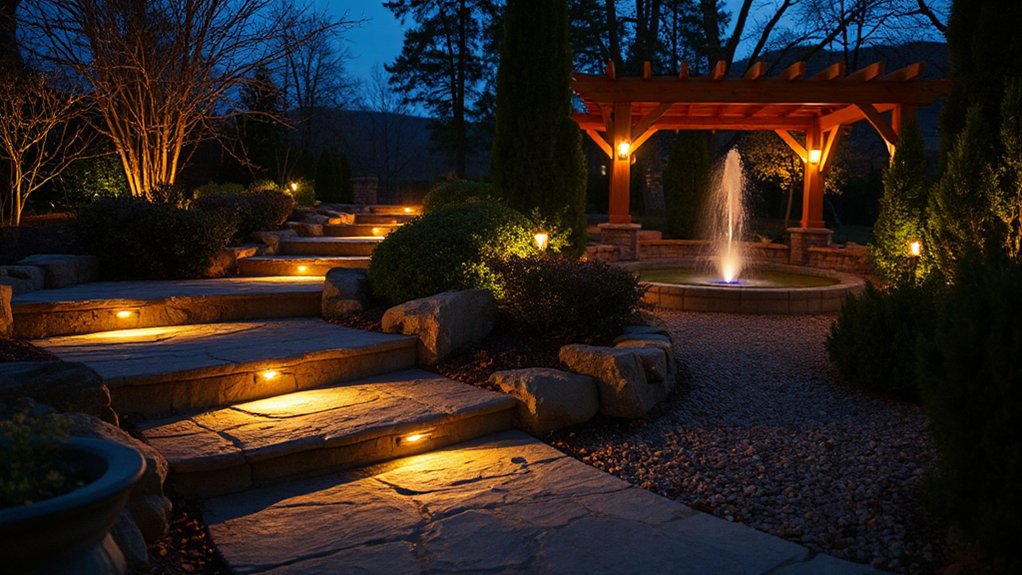
Safe pathways illuminate stairways and hardscapes with purpose, clarity, and subtlety. You optimize safety and ambiance by selecting low-glare fixtures that blend with materials, targeting steps, edges, and crossings without overlighting. Use diffused, warm temps to preserve night vision while highlighting texture and depth. Plan spacing so light falls evenly, reducing tripping hazards and glare from reflective surfaces. Integrate timers or dusk-to-dawn sensors to conserve energy and extend bulb life. Consider vertical and inset options to minimize obstruction and maintenance. Address soil nutrients nearby by avoiding buried cables and choosing stake-ready, compliant housings. Garden pests stay deterred by thoughtfully placed lighting that limits dark crevices.
- Path-light placement strategy for step lines
- Fixture color, temp, and glare control
- Wiring and safety best practices
- Maintenance and longevity planning
Landscape Focal Points: Uplighting Trees and Shrubs
Uplighting trees and shrubs creates immediate focal points while shaping the landscape’s silhouette after dark. You’ll use targeted fixtures to highlight trunks, canopies, and texture, avoiding glare and light spill that distracts from architectural forms. Select low-contrast color temperatures to preserve natural hues and reduce light pollution while preserving night vision. Position fixtures on grade or slightly inset and aim upward with shields to emphasize architectural lines without creating harsh hotspots. Consider layering: a primary uplight for the main tree, secondary accents for understory shrubs, and subtle grazing to reveal bark texture. This approach supports botanical symbiosis by encouraging healthy growth signals and reducing stress from sudden illumination. You’ll also note how soil enrichment benefits roots near illuminated zones through microclimate stabilization and moisture retention.
Water Features at Night: Reflections and Drama
Water features at night create a layered mood with Water’s Night Echoes, inviting reflections and subtle drama. Use Reflective Wave Lighting to mimic ripples and spotlight key surfaces, then pair with Dramatic Ripple Highlights to emphasize movement. This approach sharpens contrast, extends viewing windows, and positions water as a focal element in contemporary outdoor schemes.
Water’s Night Echoes
As dusk settles, carefully placed lighting transforms fountain spray, pools, and cascades into living architectural elements, creating dynamic reflections that evolve with the wind and water’s motion. You’ll amplify Water reflections with layered hue and texture, guiding attention to surface motion and edge details while maintaining clarity. Night echoes emerge as carefully timed fixtures reveal subtle motions, producing a chorus of light that reinforces form without overpowering it. Use low, warm temp shouldered by cool accents to sculpt contrast, then integrate dimming schedules to preserve ambience. Maintain clean, glare-free sightlines and monitor reflections for consistency across seasonal changes.
- Layered lighting for depth and movement
- Subtle color shifts to enhance water texture
- Directed uplight on features’ silhouettes
- Timed transitions aligned with activity cycles
Reflective Wave Lighting
Reflective Wave Lighting treats water as a living reflector, using synchronized, low-profile fixtures to sculpt dancing highlights that mirror surface motion. You’ll deploy fixtures along boundaries and perimeters to exploit gentle ripple energy, creating a seamless dialogue between water and architecture. Focus on even, soft distribution to avoid hotspots, and calibrate color temperature to enhance natural reflections without overpowering night aesthetics. Emphasize controllable intensity and timing to synchronize wave patterns with ambient surrounds, so reflections evolve as patrons move through the space. Prioritize reliability and ease of maintenance; choose rugged, weather-sealed drivers and discreet wiring. Your design should leverage Reflective surfaces and measured instrumentation to prevent glare while maximizing depth. The result is a sophisticated, tranquil nocturnal signature that highlights water features at their quietest, most elegant moments.
Dramatic Ripple Highlights
Dramatic Ripple Highlights harness the bold, kinetic energy of water to create high-contrast reflections that respond to movement and wind. You’ll spotlight ripples from a discreet pump, guiding reflections across masonry and greenery while avoiding glare on seating. Precision lighting emphasizes texture and contrast, enhancing night drama without overpowering the landscape.
- Align pump flow with architectural lines to maximize reflective geometry
- Use warm temperature LEDs to mimic moonlight while reducing glare
- Position lights to minimize garden pests and glare on glass or water surfaces
- Monitor soil health around features to prevent root stress from moisture shifts
Keep maintenance tight: seal fittings, trim debris, and test after rain. Integrate controls for seasonal adjustments, and note how water movement reshapes perception.
Seasonal Moments: Color Accents and Bi-Color Options
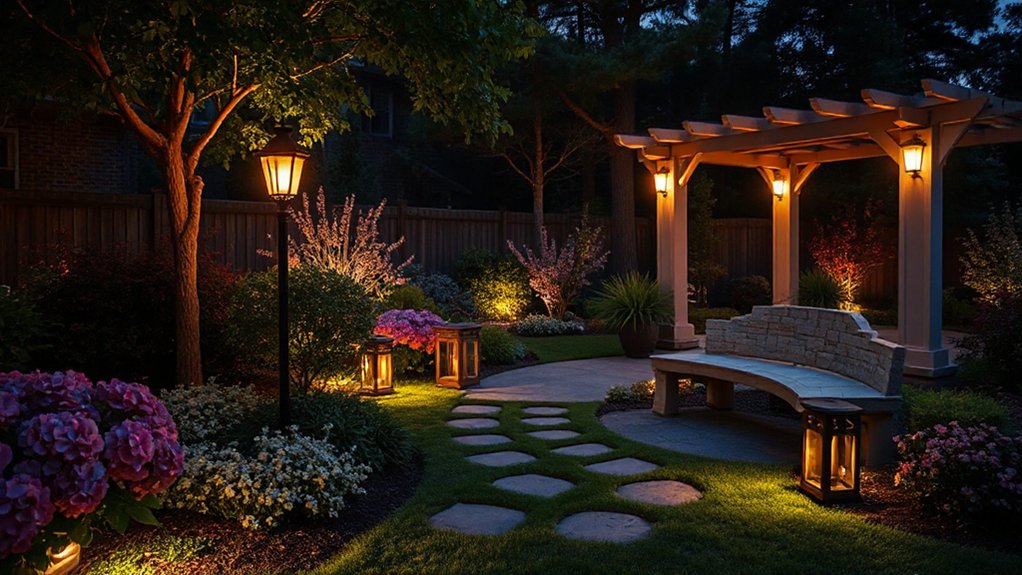
Seasonal moments in garden lighting hinge on smart color accents and clean bi-color options that adapt with the calendar. You’ll leverage seasonal color shifts to highlight garden progressions without overhauling fixtures. Implement warm hues for autumn textures and cool tones for spring silhouettes, using tunable LEDs for precise control. Bi color options simplify this through two complementary channels in a single fixture, reducing clutter while expanding palette versatility. Align color choices with plantings, textures, and outdoor furniture to maintain coherence across spaces. Maintain color consistency by calibrating drivers and checkpoints for easy sequence changes. Prioritize energy efficiency and longevity, selecting high-CRI, dimmable sources that render foliage accurately. In practice, map color calendars to events, ensuring consistent, tasteful moments throughout the year.
Weatherproofing Without Compromising Design
Weatherproofing doesn’t have to dull a design. You can protect outdoor lighting while preserving style by selecting weather-rated fixtures and discreet seals that blend with your landscape. Focus on materials that resist corrosion, UV fading, and cold starts, then pair them with durable finishes like dark bronze or matte black. Consider housing that directs water away from electronics and uses gasketed connections for easy maintenance. Prioritize low-profile silhouettes to reduce glare without compromising performance. Integrate seasonal plantings for natural protection and concealment, while maintaining accessibility for service. Align wiring with conduit, not surface mounts, to avoid tripping hazards and weather exposure. Implement pest prevention strategies to deter rodent interference.
- Durable, weather-rated fixtures and sealed housings
- Concealed wiring and conduit routing
- Low-profile, glare-conscious designs
- Seasonal plantings for protection and aesthetics
Glare Control and Light Trespass: Neighbor-Friendly Practices
Glare control and light trespass are essential for neighbor-friendly outdoor lighting. You reduce glare by choosing shielded luminaires with full cutoff optics and placing fixtures to illuminate boundaries rather than interiors. Use motion-activated, low-intensity controls for outdoor spaces, and set color temperature toward warmer tones to minimize contrast with surroundings. Implement zoning that directs light downward and away from adjacent properties, patios, and street-facing areas. Assess site geometry, adjusting height, angle, and beam spread to limit spill and skyward emission, which drives light pollution concerns. Prioritize privacy-conscious layouts—hedges, screens, or low-profile lighting at property lines—so you maintain neighborhood privacy without compromising safety. Document lighting plans for compliance and performance reviews, reinforcing responsible, commercially viable practices.
Coordination With Indoor Lighting for Seamless Transitions

You want a seamless indoor-outdoor feel, so focus on seamless progression between spaces and guarantee the lighting reads as one system. Keep color temperature consistent from room to exterior zones to avoid jarring shifts, and align dimming and scene settings across both environments. Finally, synchronize control systems so you can adjust mood and function—from day-to-night to entertaining—without juggling multiple apps or presets.
Seamless Indoor-Outdoor Transition
Seamless indoor-outdoor lighting hinges on coordinated fixtures, color temperature, and control systems that bridge spaces without drawing attention to shifts. You align luminaires so color temperature matches indoor schemes, and you centralize controls for adaptive scenes. By designing pathways that flow from interior to exterior, you preserve ambiance and safety without abrupt shift. You also consider landscape elements that impact perception, like glare and shadows, to maintain continuity. Remember to assess garden pests and soil health when selecting fixtures near planting beds, ensuring low-heat, low-impact options don’t disturb ecosystems. The result is a unified mood that invites movement between areas without distraction.
- Unified color temperature strategy across spaces
- Centralized, wireless control with scene presets
- Low-glare, shielded fixtures near entry points
- Eco-conscious placement considering pests and soil health
Color Temperature Consistency
Color temperature consistency is essential for smooth indoor-outdoor changeovers, bridging spaces with a unified seasonal feel rather than a jarring shift. You’ll prioritize matching color temps between exterior fixtures and interior lighting to preserve perceived neutrality across thresholds. Aim for a shared Kelvin range, typically around 2700–3000K for warm interiors, with exterior sources mirroring that tone to avoid color cast conflicts on materials and textiles. Implement consistent CRI values above 80 to maintain true color rendering in both domains, supporting color harmony across surfaces, furniture, and greenery. Choose fixtures with stable color output and minimal tint drift over time, boosting fixture durability under outdoor conditions. Document and maintain a library of approved luminaires and lamps to ensure ongoing consistency as you expand or remodel spaces.
Control System Synchronization
Control system synchronization is essential for smooth shifts between indoor and outdoor lighting, ensuring a unified narrative as spaces are used across day and night. You optimize progressions by coordinating dimming curves, color temperature, and scene presets across zones, so outdoor scenes mirror indoor ambiance. Smart technology enables real-time data sharing, occupancy sensing, and weather-adaptive adjustments, maintaining consistent brightness and mood. Prioritize compatibility across fixtures, controllers, and dimmers, with centralized automation that reduces lag and misalignment. This approach supports landscape aesthetics by preserving tonal harmony from foyer to patio, and by enabling seamless scene chaining for events. Focus on scalable architectures, robust networking, and user-friendly interfaces to empower editors and clients.
- Unified dimming profiles across indoor and outdoor zones
- Real-time occupancy and ambient sensing
- Weather-responsive, adaptive presets
- Centralized, intuitive control dashboards
Energy Efficiency Strategies to Extend Fixture Life
To extend fixture life and maximize energy efficiency, start with quality components and proper sizing, then optimize runtime patterns to reduce wear. You’ll gain durability by selecting industry-standard drivers, heat sinks, and corrosion-resistant housings, aligned with lumen needs and weather exposure. Employ dimming and scheduling to avoid unnecessary on-cycle hours, and prefer linear-time controls over abrupt on/off cycling. Prioritize low-power, high-efficiency LEDs and efficient optic design to minimize waste heat. Regularly verify junction temperature targets and firmware updates that optimize drive currents without sacrificing output consistency. Consider bioluminescent plants and outdoor security as complementary design cues, using shadow-safe placements that reduce foreground glare while preserving safety margins. Document energy metrics to refine maintenance cycles and extend fixture life amid evolving outdoor lighting standards.
Maintenance Routines to Keep Lighting Pristine
Regular maintenance keeps outdoor lighting reliable and efficient, so you should establish a routine that covers inspection, cleaning, and performance checks.
You operate with precision, prioritizing plant care around fixtures and avoiding glare on foliage. Inspect housings for cracks, seals, or moisture intrusion, and test illumination patterns for uniformity. Clean lenses and diffusers gently to preserve light output, and unplug power before handling wiring. Schedule seasonal checks to align with blooming cycles and pest activity, adjusting placements if plants overgrow or shade. Document performance trends to catch early failures, and replace worn components promptly. Implement pest control measures near fixtures to prevent intrusion and rodent damage while preserving electrical safety.
- Routine inspection and testing
- Careful cleaning and lens maintenance
- Seasonal performance audits
- Integrated plant care and pest control strategies
Budget-Smart Strategies: Cost-Saving Techniques That Don’t Sacrifice Impact
Smart budgeting can stretch your outdoor lighting impact without compromising quality. You can maximize effect by prioritizing durable materials and scalable layouts, so every dollar buys lasting glow rather than quick fixes. Begin with Budget planning that aligns your goals with realistic costs, focusing on long-term return rather than flash. Choose fixtures with proven material durability—polycarbonate housings, stainless steel withstands, and sealed connections—to reduce replacements from weather or corrosion. Consolidate lighting layers into a cohesive plan: ambient wash, task accents, and safety illumination, then grow cautiously as needs evolve. Opt for energy-efficient LEDs and smart controls to cut consumption without sacrificing mood. Reuse existing wiring where feasible, and invest in quality drivers and miscellaneous components to minimize maintenance demands over time.
Quick-Start Guide: A Three-Light Setup for Small Spaces
A three-light setup for small spaces delivers instant impact with minimal complexity. You’ll place one key light for facial illumination by entry points, one fill light to soften shadows, and a decorative accent to highlight texture or structure. Use warm color temperatures to maintain inviting nighttime entertainment vibes while staying energy-efficient. Aim for 20–40 percent brightness differentials to preserve depth without glare. Connect sources to a simple controller or smart switch for quick adjustments.
- Position key light at 45 degrees to your focal area
- Place fill light opposite or near the entry for even spread
- Add a low-profile accent to sculpt architectural features
- Schedule routine lighting maintenance checks and battery backups
This approach keeps small spaces functional, stylish, and ready for any outdoor gathering.
Trend Priorities for 2025 Outdoor Spaces: What to Upgrade First
If you’re upgrading outdoor spaces in 2025, prioritize lighting changes that deliver immediate impact with lasting value: weatherproof fixtures, integrated smart controls, and energy-efficient components head the list. Start with zones that unite function and ambience—pathways, entry points, and outdoor living rooms—then layer in controls that adapt to time, activity, and season. Emphasize durability and reliability: rugged housings, corrosion resistance, and sealed drivers reduce maintenance while preserving light quality. Prioritize fixtures that minimize light spill to protect wildlife habitats and support nocturnal patterns, aligning design with ecological balance. For soil health, select fixtures with low heat emission and ground-level installation to avoid root disturbance. Finally, document savings and performance metrics to validate upgrades and guide phased improvements across the yard over 2025.
Quick Reference: Selecting Fixtures and Controls for Real-World Layouts
When selecting fixtures and controls for real-world layouts, start with zones that balance function and ambience—paths, entryways, and outdoor living areas—then match fixtures to maintain light quality while minimizing spill and glare. You aim for predictable color temperature, low glare, and scalable controls for scenes that shift from dinner to late-night lounging. Consider integrated sensors for auto-off and timers to reduce energy use, while keeping safety in high-traffic zones. Plan luminaires to emphasize plant selection and structure, not drown them, and guarantee weather-rated components for pest control resilience. Balance warm and neutral tones to support nighttime plants and fauna without attracting insects.
- Zone-based layout prioritization
- Fixture-mixture strategy by function
- Sensor and control integration
- Maintenance and pest considerations
Frequently Asked Questions
How Do I Choose Lighting Colors for Seasonal Consistency?
Begin by choosing color temperature that stays consistent with the season, then layer mood lighting to reinforce it. You’ll guarantee seasonal consistency, control glare, and maintain a cohesive scene as you adapt outdoor spaces year-round.
What Budget-Friendly Upgrades Deliver the Biggest Impact?
You’ll maximize impact on a budget by adding solar options and smart controls, you savvy DIYer. Think subtle path lights, motion-activated color accents, and timers—delivering professional polish without breaking the bank, while you outsmart seasonal costs.
Which Fixtures Maximize Safety on Stairs and Paths?
You maximize safety on stairs and paths with low-profile LED fixtures and glare-free lighting, using Smart controls and energy efficiency. You install handrail-integrated lights and motion-activated sconces for consistent illumination and quick response across all elevations.
How Can I Blend Indoor-Outdoor Lighting Transitions Seamlessly?
You can blend indoor-outdoor lighting shifts by using consistent color temperature and fixtures, maintaining uniform beam angles, and layering landscape illumination with recessed, wall-wash, and path lights to create a seamless ambient glow.
What Maintenance Routine Prevents Fixture Failure in Winter?
Snow-dusted cords fade? You prep with a winter maintenance routine, ensuring solar automation units stay dry and sealed, and you protect fixture durability by testing switches, cleaning lenses, and lubricating hinges before freezes tighten their grip.
Conclusion
In 2025, your garden should feel cinematic yet effortless, with layered light guiding every step and highlight. Embrace solar, low-voltage, or line-voltage options that fit your budget, then pair ambient, task, and accent layers for depth. Use smart controls to tailor evenings and color tuning to shift mood on demand. Prioritize upgrades that elevate function without clutter. Think of your space as a stage: lighting is the spotlight, the plants are the backdrop.
About the Author


