
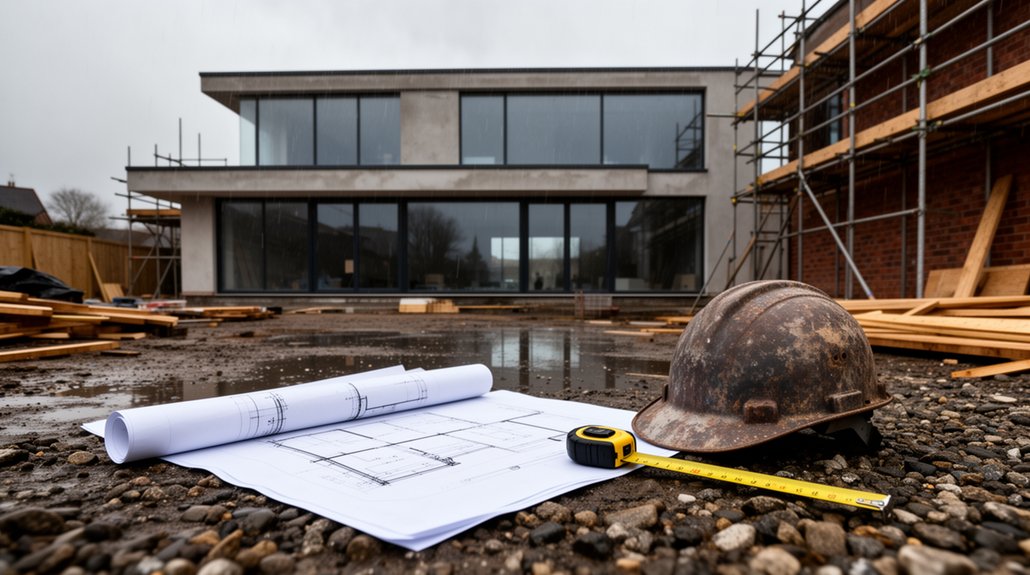
Building your UK dream home isn’t a glossy leap from Grand Designs; it’s a disciplined, data-driven process where materials, labor, planning, and financing converge to define real costs. Expect upward pressure from materials inflation, labor shortages, and planning delays, with regional price dispersion and supplier lead times shaping budgets. Use a phased, risk-adjusted cost plan that separates hard and soft costs, accounts for permits, VAT, and contingencies, and monitors procurement delays—knowing more will sharpen your cost control as you proceed.
Key Takeaways
- Real UK build costs often exceed show-home estimates due to materials inflation, labor shortages, and planning delays.
- Regional price differences and contractor capacity can create unexpected cost variances across projects.
- Hidden costs—permits, VAT, surveys, contingency buffers—significantly affect final spend beyond initial budgets.
- Detailed budgeting with phased spend, change control, and lifecycle-focused material choices reduces overruns.
- Financing, grants, and cash-flow planning are critical to managing delays and procurement-led cost escalations.
What Will UK Home Build Costs Really Hit?

Costs in UK home construction have been trending upward due to persistent drivers like materials inflation, labor shortages, and planning delays; yet, the exact trajectory remains uncertain. You’ll confront regional price dispersion, contractor capacity constraints, and supplier lead times that compress or extend build schedules. Input costs for concrete, steel, and timber sit alongside volatile finishing trades, influencing unit rates and contingency planning. Architect collaboration becomes essential to align design intent with attainable budgets, preventing scope creep through disciplined value engineering. Material selection matters: eco friendly materials can offer long-term savings but may incur higher upfront costs and sourcing risks. You’ll need robust cost-modeling that links design decisions to lifecycle costs, enabling objective tradeoffs between speed, quality, and total expenditure while maintaining code compliance.
Plan Your UK Build Budget: From Planning to Details
You’ll start by framing your UK build budget around Planning Budget Basics, then tighten the focus with a Details Cost Breakdown to avoid surprises later. This discussion keeps inputs explicit—land, permits, materials, labor, and contingencies—so you can quantify risks and allocate buffers effectively. By aligning planning assumptions with on-site realities, you’ll create a defensible budget that supports decisions from design tweaks to procurement timelines.
Planning Budget Basics
Estimating a UK build budget begins with a clear scope and a disciplined breakdown of costs, then tracks each item from planning through completion. You start with a high-level cost envelope, then subdivide into phases and risk-adjusted line items to avoid drift. Planning budget basics focus on early identification of non-project costs, such as permissions, surveys, and contingency reserves calibrated to complexity. You map out material selection implications—unit costs, delivery windows, and lifecycle efficiency—to prevent later value erosion. You embed a disciplined change-control process: every deviation triggers a documented impact assessment and revised forecast. You’ll pursue transparent assumptions, assign ownership, and align stakeholders on target margins. Contractor negotiation begins here: benchmark rates, payment terms, and scope clarity set the foundation for controlled spend rather than reactive bargaining.
Details Cost Breakdown
How should you structure a detailed cost breakdown to translate a planning budget into actionable estimates? You create a line-item ledger by phase, separating hard costs from soft costs, and assign unit rates with contingency buffers. For each item, specify quantity, unit, and source of data, then validate against market quotes. Material selection drives major variance; compare alternatives by life-cycle cost, not just upfront price, and document assumptions. Include design and permit fees, scaffolding, and site preliminaries as distinct entries. Supplier and contractor negotiations should yield a bottom-up estimate, with a documented RFI process and back-up calculations. Track escalation risk and procurement lead times to prevent overruns. Finally, synthesize the details into a transparent budget narrative that supports informed decision-making and risk-aware scheduling.
Avoid Hidden Costs: Permits, VAT, and Contingencies
Permits, VAT, and contingencies can quietly inflate project costs if you don’t account for them early. You’ll need a precise, proactive approach to avoid surprises from permitting delays and zoning restrictions that affect schedule and cash flow. Treat these costs as inputs, not afterthoughts, and map them against your baseline budget.
- Identify permit types and expected fees upfront
- Add VAT implications to material and service purchases
- Build a contingency buffer aligned to risk exposure
Financing UK Builds: Grants, Loans, and Cashflow Tricks
Financing UK builds hinges on identifying accessible grants, evaluating loan options, and smoothing cash flow with disciplined planning. You’ll assess grant eligibility by matching project type, location, and timelines to current schemes, noting any caps, eligibility hurdles, and required paperwork. Parallelly, you compare loan options—from secured mortgages to non-traditional lenders—prioritising APR, fees, drawdown schedules, and repayment flexibility. Cashflow optimization rests on staged funding, contingency buffers, and timely invoice management, so you avoid interest burdens from idle capital. Validate affordability using refreshed pro formas that account for VAT, permits, and potential cost overruns. Documented scenarios reveal sensitivity to interest rate shifts and drawdown gaps. By aligning grant eligibility insights with loan terms, you create a transparent, repeatable financing workflow that supports disciplined project pacing and final cost visibility.
Case Studies: Budgets vs. Real UK Build Realities

Case studies reveal how budget forecasts diverge from on-site realities, highlighting where initial estimates understate risks or misjudge build-rate constraints. You’ll see patterns where contingency buffers vanish as site conditions and procurement delays compound cost growth. An evidence-based view shows how sustainable materials and smart technology choices can both tighten and stretch budgets, depending on supply cycles, installer familiarity, and regional demand.
- Costs overrun when material supply narrows or backorders disrupt critical trades.
- Schedule slippage magnifies financing costs and halts progress, eroding contingency reserves.
- Lifecycle-aware selections influence maintenance expenses and resale value.
You’ll benefit by benchmarking budgets against real build timelines, auditing vendor quotes, and prioritizing modular, predictable tasks. This helps you translate design intent into controllable, auditable cost outcomes.
Build Smarter: Leaner Design and Efficient Planning
Leaning into lean design and precise planning reduces waste and accelerates delivery by tuning scope, materials, and sequencing from the outset. You optimize decisions through a structured brief, modular components, and validated procurement profiles, cutting change orders and schedule slips. Emphasize load paths, thermal performance, and daylighting to align performance targets with cost. In practice, you sequence work to minimize handoffs, align trades, and consolidate site logistics, lowering risk and enhancing predictability. Choose sustainable materials where performance, embodied energy, and durability meet project goals, without inflating complexity. Integrate design reviews with cost engineering to catch deviations early. Embrace innovative architecture that leverages prefabrication, smart detailing, and adaptable layouts, delivering tighter budgets and faster delivery while maintaining quality and long-term value.
Frequently Asked Questions
How Long Does the Average UK Build Take From Start to Finish?
You’ll typically complete an average UK build in about 12–18 months. You’ll need design inspiration loops and precise material sourcing, with contingency buffers. You’ll manage timelines analytically, tracking permits, trades, and inspections to avoid costly delays.
What Inflation Trends Most Affect On-Site Project Costs?
Material delays and labor shortages most affect on-site costs, you’ll see prices swing with supply gaps, contractor availability, and wage pressures. You monitor inflation-driven spikes, scheduling impacts, and procurement lead times to keep budgets on track.
How Can You Minimize Professional Fees Without Losing Quality?
You minimize professional fees by prioritizing design flexibility and prudent material selection; you negotiate scope early, use standardized details, and integrate value engineering. You track cost drivers, solicit multiple bids, and document decisions to preserve quality and accountability.
Do UK Builders Use Fixed-Price Contracts Effectively?
You’ll find UK builders use fixed-price contracts selectively; contract flexibility varies, but you should demand clear scope and milestones. This supports budget management, yet beware change orders. When used correctly, fixed-price contracts balance transparency and risk.
What Contingency Percentage Is Truly Safe for Surprises?
A safe contingency is not fixed, you should target 10–20% of your budget for contingency planning and budget buffers. You’ll monitor risks actively, adjust forecasts regularly, and maintain transparent reserves to absorb unforeseen costs.
Conclusion
You’ll save more than you think by treating costs as a chain, not a guess. Track every line item, from permits to finishing touches, and bake contingencies into the budget from day one. Tie design choices to ongoing value—lean layouts, modular specs, and efficient systems pay back faster than flashy but costly add-ons. In short, plan meticulously, forecast honestly, and monitor relentlessly, because a well-calibrated build is a precision instrument, not a roll of the dice.
About the Author